
Motorized Pergola Power Outage in South Florida: Manual Override, Screens and Backup Power
Nobody asks it at the design meeting. Everybody asks it the first week of hurricane season. What happens in a motorized pergola power outage, when the grid drops and the louvres are open? Or worse, when the screens are down and the motor will not lift them? The answer matters more here than almost anywhere. We lose power routinely: summer thunderstorms, feeder faults, and named storms that take days to restore.
This guide explains exactly what happens, what manual override actually looks like on each component, and what we recommend homeowners do before the season starts. It is written from service calls, not from a spec sheet.
What actually stops working in a motorized pergola power outage
A motorized louvred roof has three electrical subsystems, and they fail differently. The louvre drive motors stop. Blades hold whatever position they were in when power dropped. The lighting and fan circuits stop. The control layer stops responding. Because most hubs talk to your router, the app goes dark even when the motors hold residual charge.
Critically, the blades do not fall open or slam shut. The gear drives in a quality louvred system are self-locking. Blade position therefore holds mechanically rather than electrically. That is a deliberate safety decision, and the most reassuring fact about a motorized pergola power outage.
Motorized screens behave the same way. A screen that was down stays down. A screen that was up stays up. Nothing unspools.
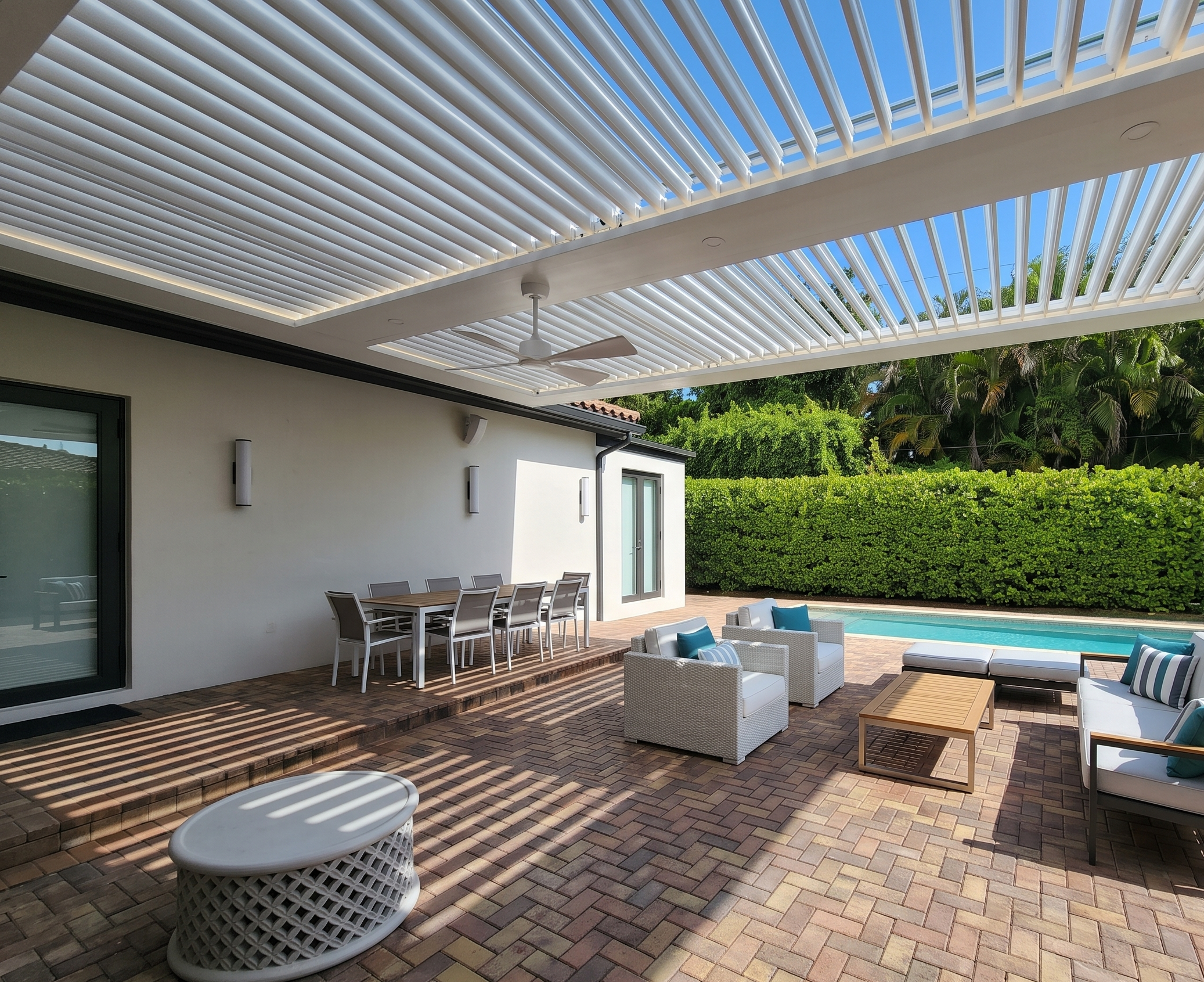
Manual override during a motorized pergola power outage
Manual override is the part homeowners most need to understand, and it varies by component. Ask your installer to demonstrate it at handover, and ask again at the first service visit if you have forgotten.
Louvre blades
Most residential louvred roof systems do not offer a hand crank for the blades. The drive is a sealed linear actuator or a gear motor. There is no user-serviceable manual position control. In practice this rarely matters. A closed roof sheds water, an open roof vents heat, and either state survives a few days.
Motorized screens in a power outage
Screens are where manual override genuinely exists. Many tubular screen motors offer a manual crank override or battery-powered emergency operation. It depends on the motor family your installer specified. If yours has a crank eyelet, look for a removable cap at one end of the headbox. A hooked rod will be stored somewhere in the garage. Find it now, not during a motorized pergola power outage.
What to do if there is no override
If your system has none, the honest answer is that you wait. Do not attempt to force a screen up by hand or lever a blade with a tool. Both damage the drive. The repair costs far more than waiting for utility restoration.
Preparing before a motorized pergola power outage
The single most useful habit is a pre-storm routine, and it takes about two minutes. When a watch is issued, retract every motorized screen fully into its headbox. Then set the louvre blades to closed. Retracted screens are protected inside the housing. Closed blades present the smallest profile and the load path the structure was engineered for.
We say this in every screens article. It costs us upsells and it is still true: a motorized screen is not storm protection. Solar mesh, insect mesh and clear vinyl handle sun, bugs and wind-driven rain. They do not handle design-level hurricane pressures or debris impact. Retract them. Our guide to motorized hurricane screens in South Florida explains where the line sits, and are pergolas hurricane proof covers the structure itself.
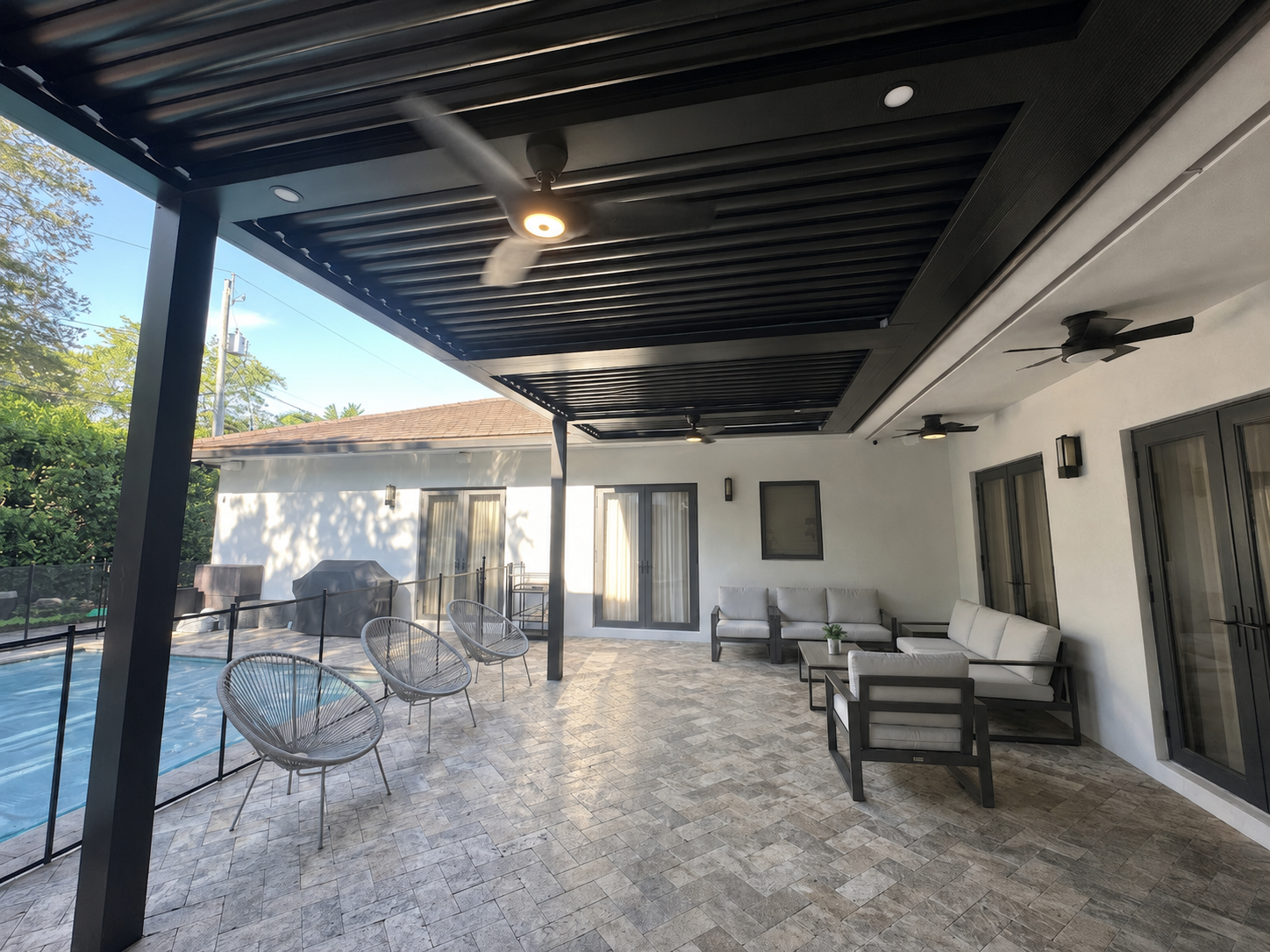
Backup power options for a motorized pergola power outage
Three approaches show up on our projects, and they suit different budgets.
Whole-home standby generator
If you already have a standby generator, ask your electrician whether the pergola circuits sit on the essential-loads panel. Most do not by default. Moving them is usually a small change at the panel rather than a rewire. This is the cleanest way to keep everything working during a motorized pergola power outage.
Battery backup on the control circuit only
A small uninterruptible supply on the hub and keypad keeps the control layer alive. You can then operate anything with its own stored power. It will not run louvre motors. It does prevent a full reconfiguration when power returns.
Battery-operated screen motors
Some screen motor families are battery-powered by design and charge from a small solar panel or a periodic plug-in. These operate straight through an outage. They suit retrofits, and sites where running conduit is difficult. Discuss the trade-offs with your installer, because battery motors have their own maintenance rhythm.
Wiring decisions that shape a motorized pergola power outage
The electrical design is worth getting right the first time. All wiring in an outdoor structure must comply with the National Electrical Code, as adopted by the Florida Building Code. That covers GFCI protection, wet-location-rated devices and correct conduit. A licensed electrician pulls that permit. It is separate from the structural permit.
Ask for the pergola to sit on its own dedicated circuit rather than sharing with pool equipment. A shared circuit means a pool pump fault takes your roof offline. That is avoidable. Ask also for a clearly labelled, accessible disconnect, because a service technician will need it.
Product approval is not structural approval
Worth repeating whenever code comes up. A Florida Product Approval confirms a product met a standard within the sizes and pressures it was tested at. It is not an approval of your structure at your address. Every StruXure build we install is engineered site-specifically for its span, exposure category and address. That engineering is what the building department reviews. Verify any product yourself on the Florida Product Approval search.
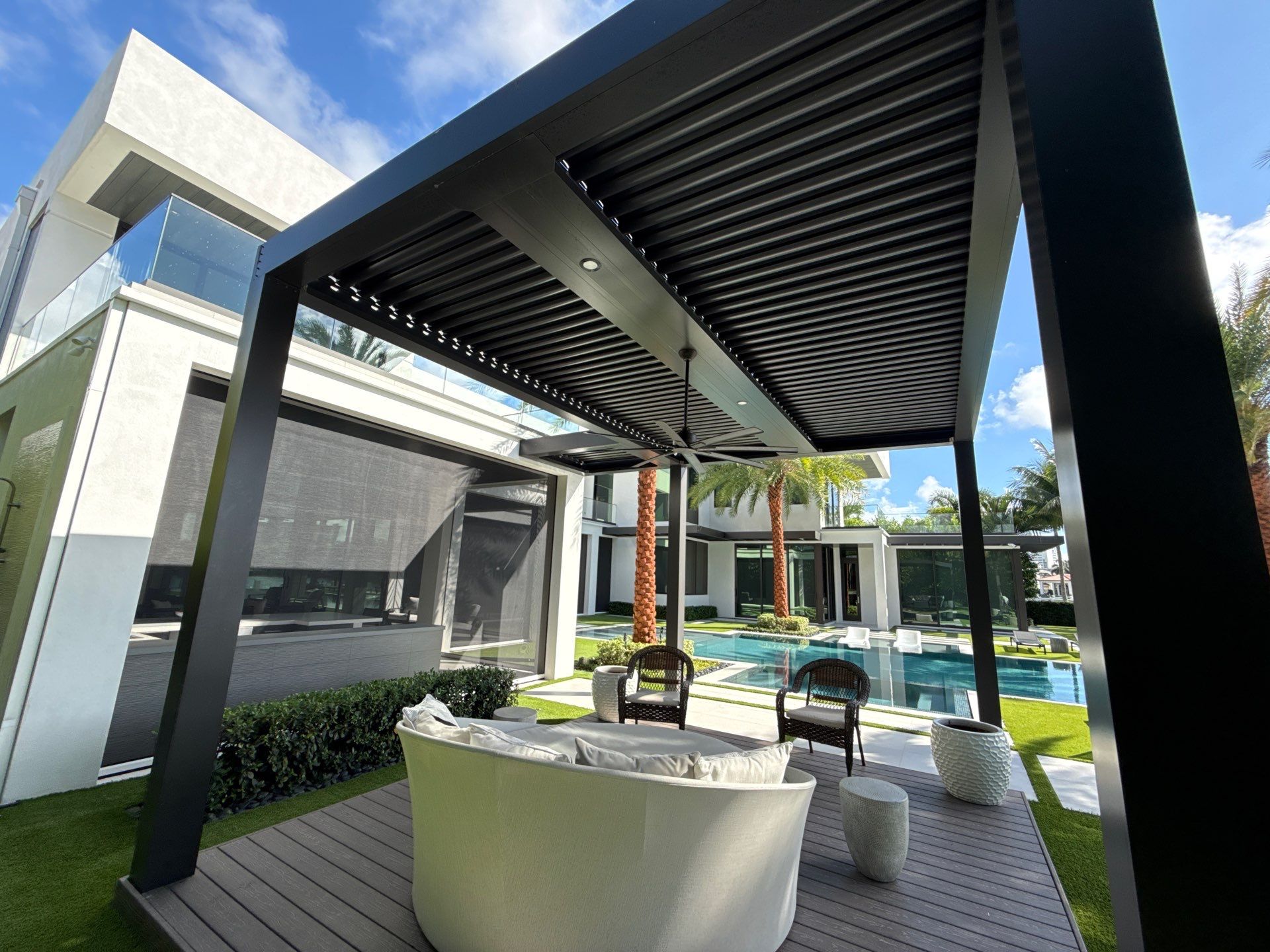
When power returns after a motorized pergola power outage
Restoration is rarely clean. Expect a brownout or two, and expect the hub to take several minutes to rejoin the network. Give it fifteen minutes before assuming anything is broken. If a keypad stays unresponsive, power-cycle the circuit at the breaker once. Wait a full minute, then try again.
If a single screen or a single louvre bank behaves oddly after a motorized pergola power outage, do not keep cycling it. Repeated attempts against a jammed drive turn a cheap service call into an expensive one. Note what it does and call your installer. Our guide on choosing a pergola contractor in Florida explains why local service coverage beats the sticker price.
What a technician checks after a motorized pergola power outage
If something is genuinely wrong, the diagnostic sequence is fairly predictable, and knowing it helps you describe the fault accurately on the phone.
First comes supply: is the circuit live at the disconnect, and is the GFCI device tripped? A tripped GFCI accounts for a surprising share of post-storm calls, and it often trips because water found its way into a device box during the same weather that took the power out.
Second comes the low-voltage side. Louvre and screen motors run through a controller, and that controller has its own fusing. A surge can take out a fuse or a driver board while leaving the motor itself perfectly healthy.
Third comes the motor. Technicians test it directly, bypassing the controller, to confirm whether the fault sits upstream or in the drive. Only then does anyone talk about replacing hardware.
Describing which of those three layers is behaving oddly — no power at all, power but no response, or a motor that hums without moving — will get you a faster and cheaper visit.
Frequently asked questions
Will my louvres open on their own during a motorized pergola power outage?
No. The drives are self-locking, so blades hold their last position mechanically. They neither open nor close without power.
Can I lower my screens manually during a motorized pergola power outage?
Only if your motor family includes a crank override or battery operation. Many do not. Never force a screen by hand.
Should I close the louvres before a storm?
Yes. Closed blades present the smallest profile and match the load case the structure was engineered for. Retract all screens fully as well.
Does a surge protector help?
A whole-home surge protective device at the panel is worthwhile. It protects the control electronics, which are the most surge-sensitive part. It does not keep anything running during an outage.
Is a generator worth it just for the pergola?
On its own, rarely. As part of a whole-home standby installation you already wanted, adding the pergola circuits is usually inexpensive.
Plan for the outage before the season
Every South Florida homeowner will sit through a motorized pergola power outage eventually. Know where the override rod lives, which breaker feeds the roof, and what the pre-storm routine is. That turns a stressful evening into a non-event. Review the Ready.gov hurricane guidance for the rest of your household plan. Then talk to our team if you want your system walked through before June.