
Shade Sail vs Pergola in South Florida: Wind, Rain, Lifespan and Cost
The shade sail vs pergola question comes up on almost every South Florida backyard project, usually because the sail quote arrives first and it is dramatically cheaper. That price gap is real. Nevertheless the two products solve different problems, they age very differently in this climate, and only one of them stays up when a named storm approaches.
Here is an honest comparison of what each one does in Miami-Dade, Broward and Palm Beach counties, and where each genuinely wins.
Shade sail vs pergola: the short version
A shade sail is tensioned fabric stretched between anchor points. It blocks a large share of ultraviolet light, it costs the least, and it goes up quickly. A pergola is an engineered structure with columns, beams and a roof. It costs more, it needs a permit, and it creates usable covered space rather than filtered light.
Put simply: a sail changes how a space feels, and a structure changes what the space can be used for. If you want to hang a fan, run power, mount a television or eat outside during a thunderstorm, the sail cannot get you there.
Rain performance is the biggest practical difference
South Florida gets roughly 60 inches of rain a year, and most of it arrives in short, heavy afternoon bursts between June and October. Shade fabric is deliberately permeable. Water passes through it, and even the tighter weaves shed rather than drain, so water sheets off the low corner in a single stream.
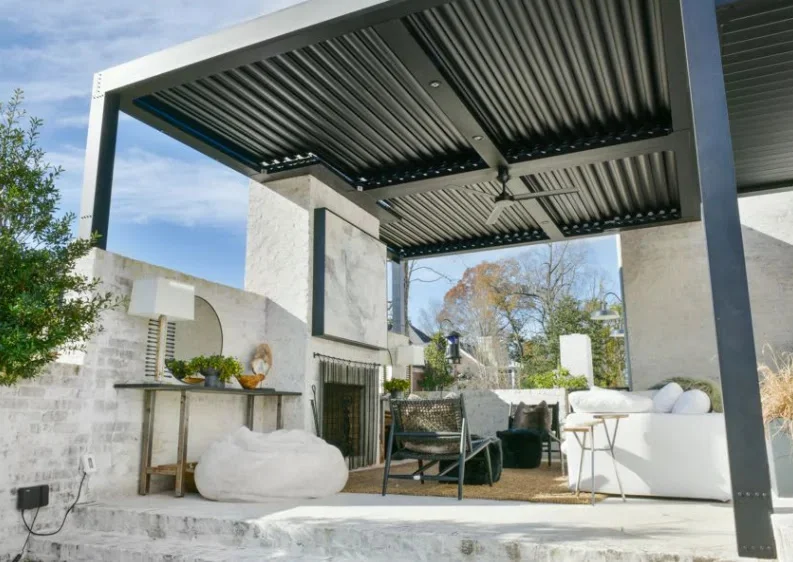
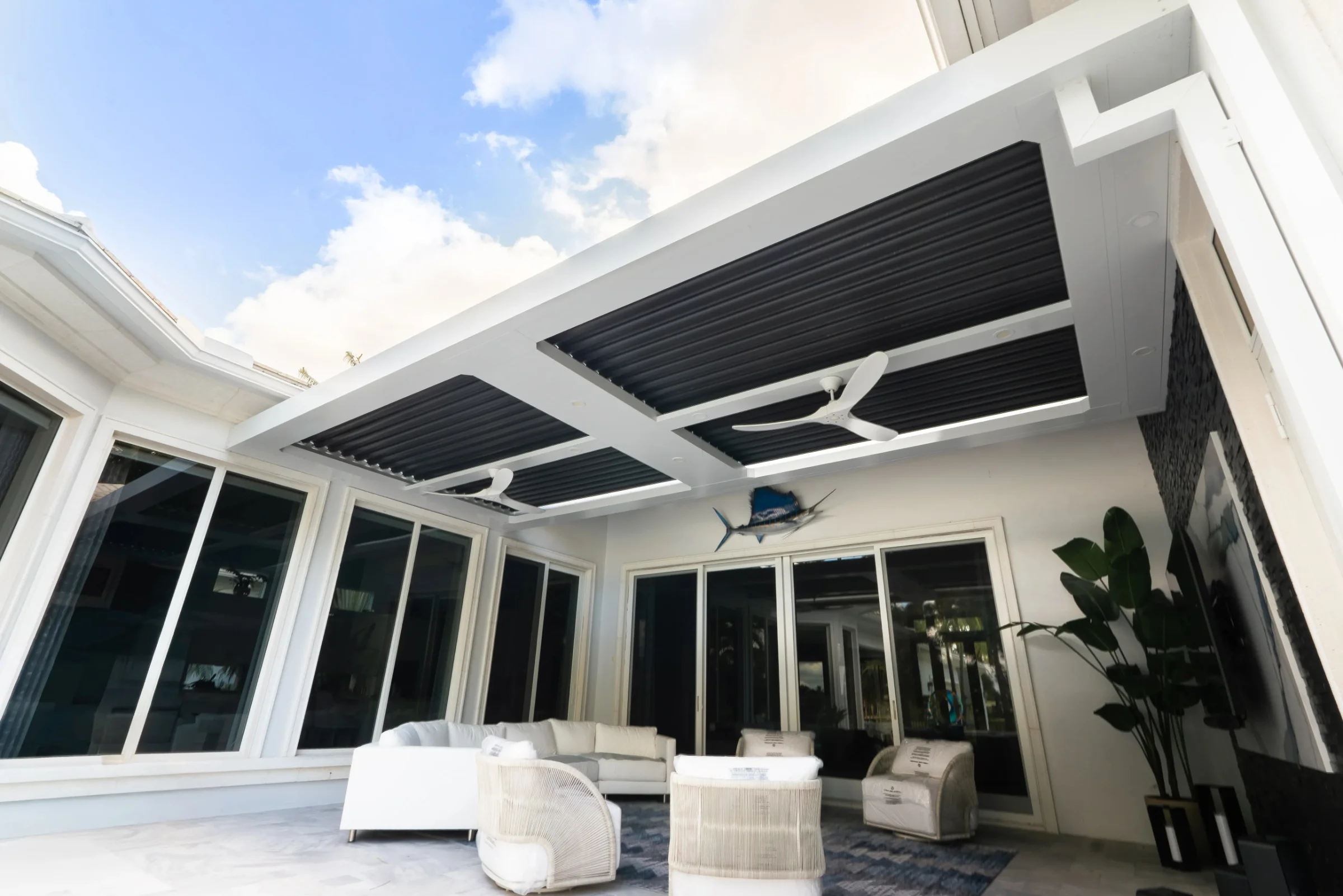
A solid or operable roof with integrated gutters collects that water and routes it to a downspout. That single difference decides how often a family actually uses the space in summer. Meanwhile an operable louvered roof adds a further trick: the blades close for the storm and open again afterwards, so the space is not permanently dark. We explain the mechanics in adjustable louvered roof systems.
Shade sail vs pergola in a Florida hurricane season
This is where the comparison stops being close.
Shade sail manufacturers almost universally instruct owners to remove the sails before a named storm. The fabric acts as a very large sail — the name is not accidental — and the loads it can transmit to its anchor points during a hurricane exceed what residential posts are designed to take. So someone has to take them down, store them and put them back up, potentially several times in a season.
An engineered aluminium structure is designed to stay. In South Florida that means design wind speeds of roughly 170 mph and above, with Miami-Dade adding its own High-Velocity Hurricane Zone product-approval regime. Critically, the engineering is done for the specific address, its exposure category and its soil, not from a generic catalogue page. The current code text is published at floridabuilding.org, and our article on how these structures behave in a storm goes deeper.
How long each one lasts here
Florida ultraviolet exposure is punishing. Quality shade fabric carries a warranty in the range of eight to ten years, and in practice South Florida installations often fade, stretch and need retensioning well before that. Salt air accelerates it near the coast.
Extruded aluminium with a quality powder-coat finish behaves differently. The finish is the wear item, and the structure underneath does not rot, warp or feed termites. That is the same reason we generally steer homeowners away from timber in replacing a wood pergola in South Florida. Specify the fasteners properly, though — mixed metals near salt air corrode fast, as we set out in galvanic corrosion in coastal Florida.
Permits, setbacks and the paperwork gap
A pergola is a permitted structure. Expect sealed engineering, a site plan, setback and lot-coverage review, and an inspection. Our Florida pergola permit guide walks through the process, and setbacks and lot coverage covers the zoning constraints.
Shade sails occupy a grey area. Small sails on temporary posts often fall below the permitting threshold, while large permanent installations on structural posts frequently do not. Homeowners get caught out here surprisingly often. Ask your building department directly, because an unpermitted permanent structure becomes a problem during a sale — a scenario we cover in permit history and the home sale.
Shade sail vs pergola on cost
The gap is wide and it should be stated plainly.
A residential shade sail installation typically lands in the low four figures for a modest span with proper posts and footings. A DIY kit costs far less and lasts far less. An engineered louvered structure is a five-figure project, driven by span, column count, motorisation and site access more than by square footage. Our South Florida cost guide breaks down what moves the number.
Compare lifetime cost rather than sticker price, though. Two or three sail replacements plus seasonal removal labour narrows the gap considerably over fifteen years, and only one of the two options adds documented, permitted structure to the property. We looked at that in do pergolas add home value.
Shade sail vs pergola: where the sail genuinely wins
Sails deserve credit where it is due. They are the better choice when the budget is firmly fixed, when the space is a play area or a parking spot rather than a living area, when the shape is irregular, when a renter needs something reversible, or when shade is wanted only for a season.
They also look excellent over informal spaces. A sail over a hammock or a sandbox is a good buy. A sail over a dining table you intend to use in August is not.
Shade sail vs pergola questions from South Florida homeowners
Which shades better, a shade sail or a pergola?
A quality sail blocks roughly 85–95% of ultraviolet light but transmits heat and lets some direct sun through the weave. A solid or closed louvered roof blocks essentially all direct sun. Ultraviolet risk is well summarised in the EPA’s sun safety guidance.
Can a shade sail stay up during hurricane season?
Manufacturers generally say no, and most warranties assume removal before a named storm. An engineered aluminium structure is designed for the wind speed at its address and stays up.
Do I need a permit for a shade sail in Florida?
It depends on size, permanence and your municipality. Large permanent sails on structural posts often do need one. Confirm with your building department rather than assuming.
Can I add lighting or fans to a shade sail?
Not to the fabric itself. Anything electrical needs separate structure to mount on. That constraint pushes many homeowners toward a roof once they see what they actually want to do with the space — see ceiling fans under a louvered pergola.
Choosing between them
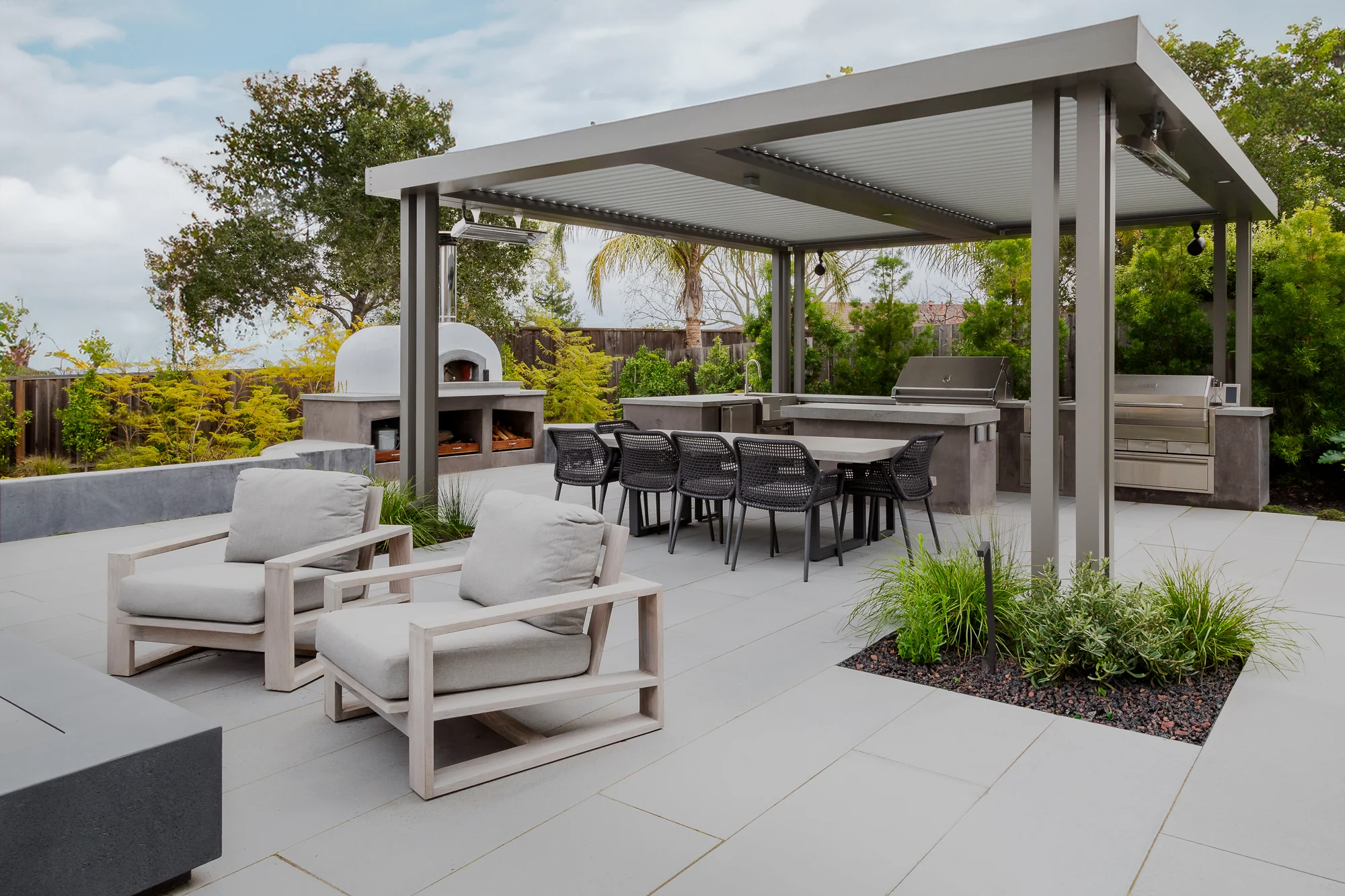
Answer one question honestly: do you want filtered light, or do you want an outdoor room? Filtered light over an informal space is a sail’s job, and it does it cheaply. An outdoor room that works in August rain, carries a fan and a television, and stays up through hurricane season is a structure’s job. StruXure South Florida engineers each installation for its specific address across Miami-Dade, Broward and Palm Beach counties. If you are weighing other options too, our comparison of motorized pergolas in Florida is a useful next read.