
Fire Pit Under a Pergola in South Florida: Clearances, Fuel and Louvered Roofs
A fire pit under a pergola is one of the most requested combinations we hear about in South Florida, and one of the least understood. Homeowners picture the evening: louvers open, a fire going, nobody swatting mosquitoes. Then the questions arrive. Will the heat damage the roof? Is gas or wood safer? Does the fire department care?
The short answer is that the combination works well when the fire feature and the structure are planned together. It goes wrong when a fire pit is dropped under a roof that was never sized for one.
Can you put a fire pit under a pergola?
Yes, with conditions. The louvered roofs we install are extruded aluminium, so they do not burn, but sustained radiant heat still matters. Aluminium finishes discolour before the metal itself is at any risk, and the motor, sensors and wiring inside the frame have far lower tolerances than the louvers.
So the question is never whether the roof will catch fire. It is whether the heat plume from your specific unit, at the height it sits, will reach components that were not designed for it. That depends on clearance, fuel and how you use the roof.
Clearance comes before style
Every manufactured fire feature ships with a stated clearance to combustibles above and around it. Treat that number as a floor, then add margin for the non-combustible parts that still dislike heat: powder coat, LED strips, speakers, a ceiling fan.
Two things reduce the clearance you actually get. Ceiling fans and heaters mounted under the louvers sit lower than the roof itself. Furniture placement also pulls people and fabric closer to the flame than the drawing showed.
Because our structures are engineered per address, the fire feature belongs on the plan from the start. Adding it afterwards usually means moving it further from the house than anyone wanted.


Gas, propane or wood: which fuel suits a fire pit under a pergola
Gas and propane units win under a roof, and it is not close. They produce controlled flame heights, no sparks, no embers, and very little smoke. A gas fire table with a lava or glass media bed is what most of our clients end up choosing.
Wood burns hotter, throws embers and creates smoke that has to go somewhere. Under any cover, that somewhere is the underside of the roof and your guests. Wood also leaves ash and resin that stain surfaces and finishes.
- Natural gas. Plumbed by a licensed gas contractor, no tanks, consistent flame. Needs a permit for the gas line.
- Propane. Flexible placement, but tank storage has its own rules and the tank needs ventilation.
- Wood. Best kept in an open area away from the structure. Under a louvered roof we generally advise against it.
Louvers open, louvers closed: the roof position matters
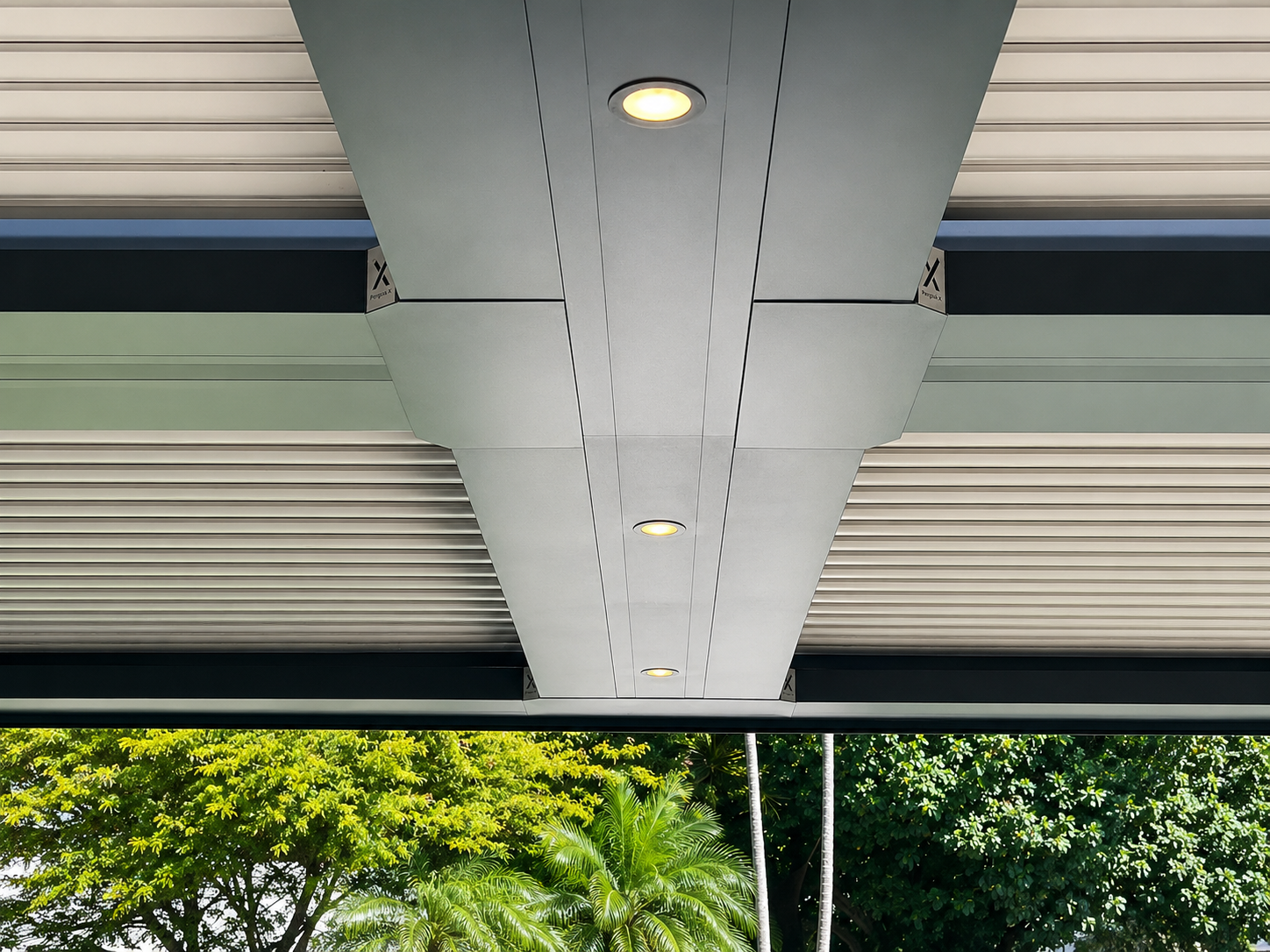
An adjustable roof gives you an option a fixed cover never will. With the louvers open, heat and any combustion gases rise straight through the gaps. With them closed, the roof becomes a ceiling, and a burning fire pit under a pergola in that position is a different situation.
Our advice is simple. Run the fire with the louvers open or well past halfway. Close them for rain, not for fire. If a shower arrives mid-evening, turn the burner off before the rain sensor closes the roof.
The same logic applies to motorised screens. Screens down on all sides plus a lit burner reduces airflow, so treat the screened configuration as an enclosed space and keep the flame off until the screens are up.
Surfaces, wind and the salt-air factor
Set the unit on a non-combustible surface such as pavers, travertine or a concrete pad. Composite decking and outdoor rugs belong well outside the heat zone.
Wind matters more here than inland. An afternoon sea breeze pushes the flame sideways and lengthens the heat plume in one direction, so leave extra clearance on the downwind side, not just overhead.
Salt air also attacks burners, valves and ignition modules. Choose marine-grade stainless components for anything within a few miles of the coast, and cover the unit when it is not in use.
Codes, HOAs and who to ask
Florida adopts a statewide fire code, the Florida Fire Prevention Code, which local fire officials enforce and which counties and cities may amend for their own community. Open-flame rules for residential patios therefore vary by jurisdiction, and the local fire marshal is the right person to ask.
Gas lines need a permit and a licensed installer. Many homeowners associations also regulate open flames and propane storage, so check the covenants before ordering anything.
Our guide to grilling under a pergola covers the related clearance and ventilation questions for cooking appliances, and our Pergola X and residential pergola pages show how the roof and the fire feature can be planned together. Contact us to talk through a layout for your property.
Frequently asked questions
Does a fire pit under a pergola need a permit?
A portable propane unit usually does not, though HOA rules may still apply. A plumbed natural gas line always requires a permit and a licensed gas contractor, and the fire feature itself may need approval where it is built in. Ask your local building department and fire official.
Can I use a wood-burning fire pit under a louvered roof?
We advise against it. Embers, smoke and resin all travel upward, and the roof and its components take the damage. If you want wood, place the pit in the open beyond the edge of the structure.
How much clearance does a fire pit under a pergola need?
Start with the manufacturer’s stated clearance for your unit, then add margin for fans, heaters, lighting and finishes that sit below the roof. There is no single number that covers every fire feature and every structure, which is why we plan the two together.
Will the heat damage a louvered roof?
Aluminium louvers do not burn, but finishes and electrical components can be affected by sustained heat. Correct clearance, gas rather than wood, and running the fire with the louvers open keep the roof well within its comfort zone.