
Pergola Automation and Smart-Home Control: What to Specify Before the Slab Is Poured
Pergola automation is the half of the project nobody photographs. The louvres are the part everyone looks at. The part that determines whether you actually use the structure is the control system behind them — the motors, the sensors, the keypad on the wall, and whether any of it talks to the rest of the house.
Pergola automation is also the part that is hardest to change later. Motors can be serviced and remotes can be replaced, but the conduit path, the circuit, and the sensor location are decided during construction. Get those three right and the pergola automation is invisible for a decade. Get them wrong and you live with a workaround.
How pergola automation actually moves a louvered roof
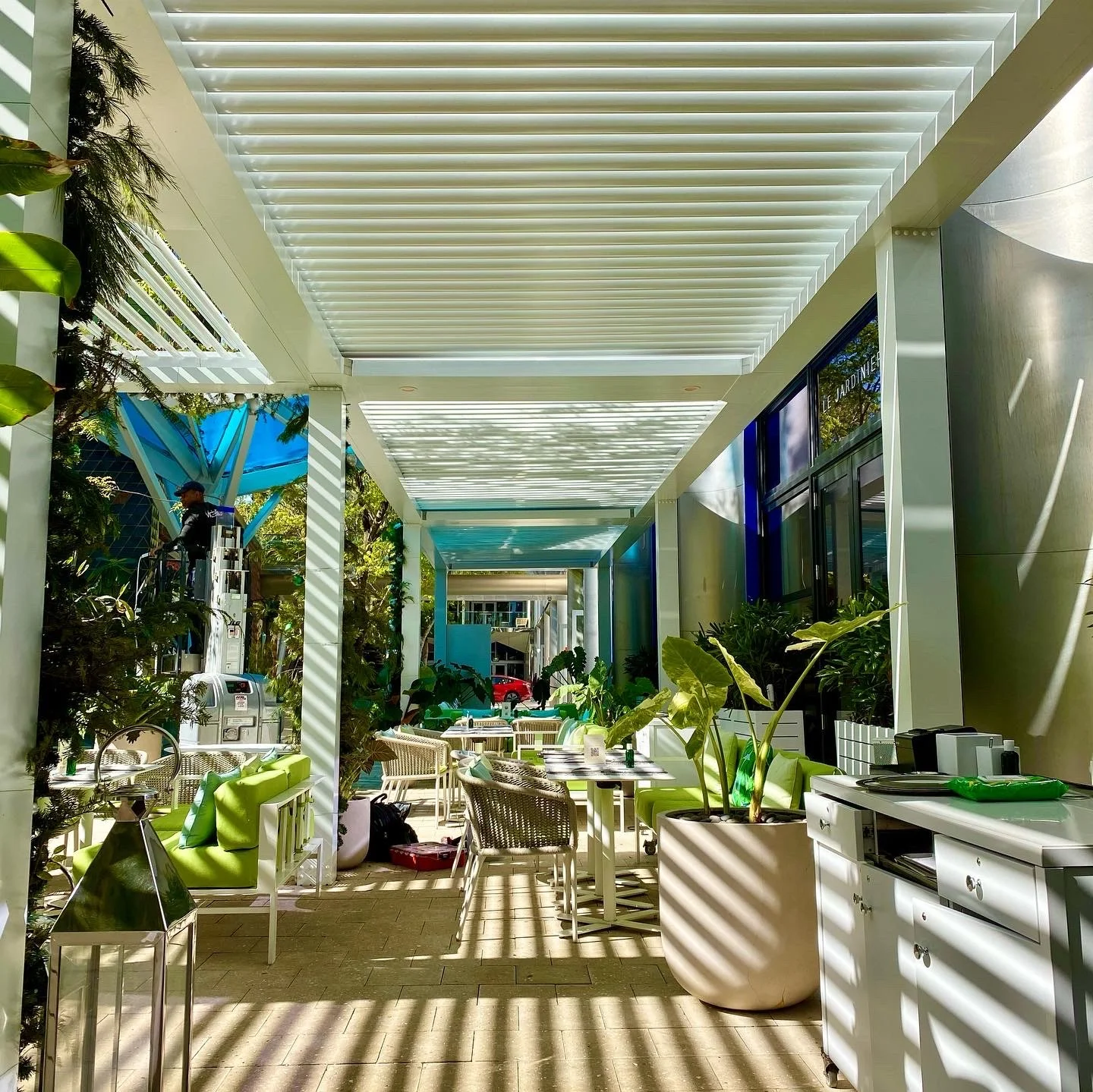
An adjustable louvered roof rotates its blades through a linkage driven by an electric actuator — the mechanism explained more fully in our guide to adjustable louvered roof systems. The blades are mechanically tied together so the whole bank moves as one unit, from fully open — effectively a slatted pergola with sky between the blades — to fully closed, where the louvres seal against one another into a solid roof plane.

Larger roofs are divided into multiple zones, each with its own motor. That matters more than it sounds. Zoning lets you close the section over the dining table while leaving the section over the lounge chairs open, and it means a single motor is never asked to drive an unreasonable span. On any structure past a certain size, zoning is a structural and mechanical necessity rather than a luxury option, and it is standard practice on the motorised pergolas we build across Florida.
What this all runs on is low-voltage control from a transformer fed by a standard branch circuit. The consequence for the homeowner is straightforward: the pergola needs power, and where that power comes from is a decision that belongs on the electrical plan, not on a punch list. The broader electrical picture — circuits for lighting, heaters, fans and outlets under the roof — is covered in our guide to designing an engineered louvered structure and should be coordinated as one package.
Rain sensors: useful, and routinely installed wrong
A rain sensor closes the louvres automatically when it detects precipitation. On paper it is the single best pergola automation feature available — you are at work, the afternoon storm arrives, and the roof closes itself over the furniture.
In practice its usefulness depends almost entirely on where it is mounted. A sensor tucked under an eave, beneath a tree canopy, or on the sheltered side of the structure is protected from exactly the thing it is supposed to detect. It will sit dry through a driving storm while rain reaches the patio from the other direction. The sensor must be in open exposure, and it must be reachable for cleaning, because a sensor caked in salt film and pollen is a sensor that has stopped working without telling you.
There is a second decision that trips people up: what happens after the rain stops. Most systems will close on detection and then reopen after a dry-out delay. Whether you want that automatic reopen depends on how you use the space. Households that leave cushions out generally do not.
Wind sensors and why pergola automation matters more here
A wind sensor moves the louvres to a defined safe position when wind speed crosses a threshold. In South Florida this is not a convenience feature. An open louvered roof presents a very different profile to wind than a closed one, and the ability to have the structure put itself into its intended position without anybody being home is worth specifying.
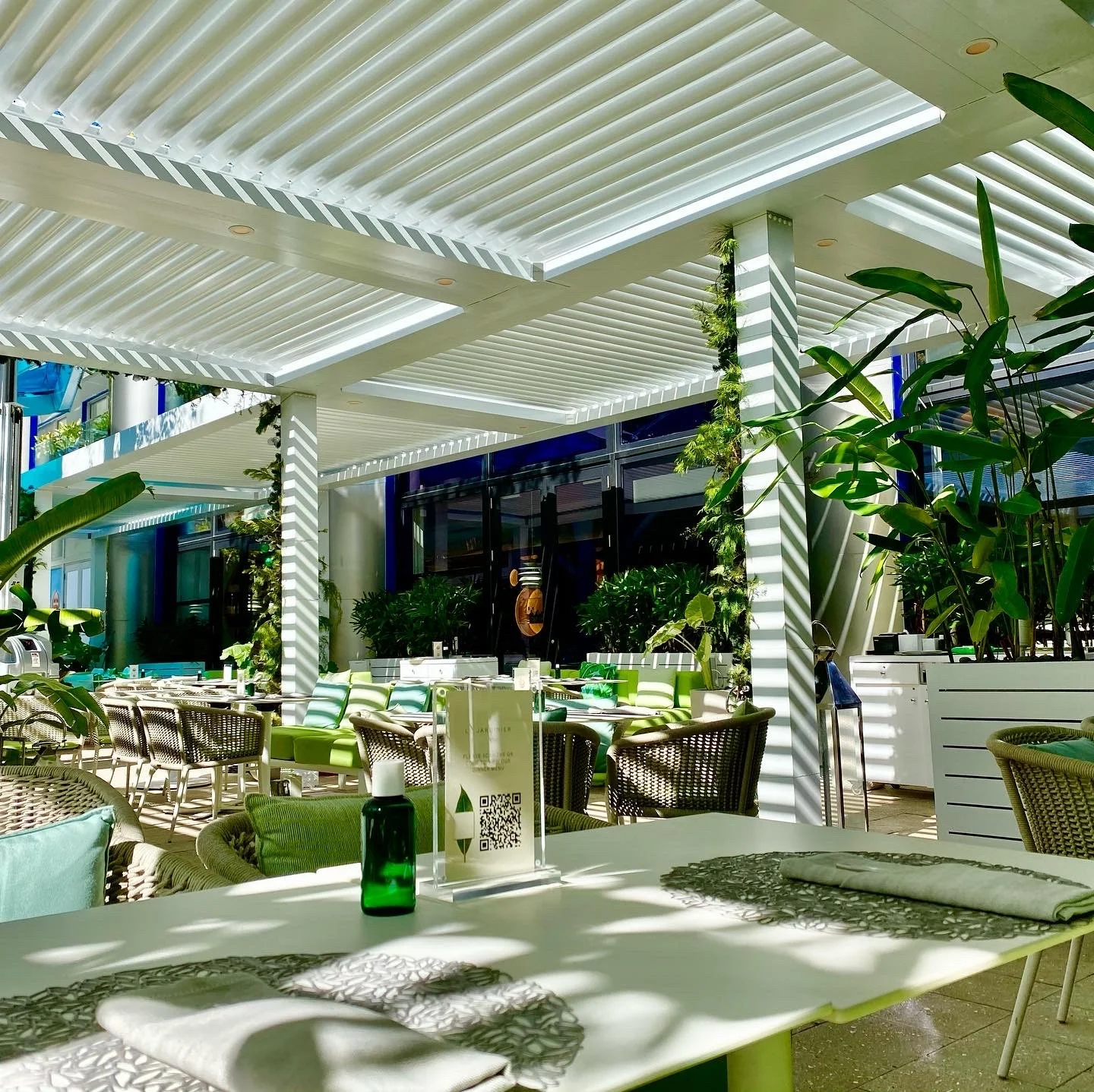
Two points worth understanding clearly. First, the threshold should be set by whoever engineered the installation, not chosen from a menu because a number sounds cautious — the structure is designed to specific loads for its specific address, and the sensor setting belongs to that design. Second, and this cannot be overstated: an automated sensor is not a hurricane plan. It handles a squall line on a Tuesday afternoon. Preparing an outdoor structure for a named storm is a separate, manual process, which we cover in detail in the discussion of how these structures perform in hurricane conditions.
The four ways people actually control pergola automation
Most pergola automation packages end up with more than one of these, and the redundancy is deliberate — each has a failure mode the others cover.
- Handheld remote. Fast, intuitive, and the one that ends up under a cushion. Fine as a primary control, poor as the only one.
- Wall keypad. A fixed control mounted at the door or under the covered area. This is the one guests can use and the one that still works when a battery dies. Its location needs deciding early because it needs a wire.
- Mobile app. Control from anywhere, plus scheduling and status. Depends on your Wi-Fi actually reaching the structure — which, if the pergola sits at the far end of a property behind a masonry wall, it may not. Coverage is worth testing before you rely on it.
- Integration with a home automation system. The roof becomes one device among many, so it can participate in scenes: an “evening” scene that closes the louvres partway, dims the landscape lighting and starts the music.
Pergola automation and what “works with my smart home” really means
This is the question that generates the most confusion, because “compatible” covers two quite different arrangements.
The deeper form is a native driver — the automation platform has purpose-built support for the roof, so the controller knows louvre position, can report status back, and can set intermediate angles. This is the better experience and it depends on the specific platform and the specific control system version.
The simpler and far more universal form is contact-closure integration. The automation system triggers open, close, or a preset position by momentarily completing a circuit, exactly as a wall button would. You lose feedback — the controller is telling the roof what to do without knowing what it did — but it works with essentially any platform, and for scene-based use it is often entirely sufficient.
The practical instruction is the same in both cases and it needs saying to two trades at once: tell your AV integrator and your pergola installer about each other, in writing, before rough-in. The integration is nearly free if a low-voltage run is pulled while the walls are open. It is a wall-opening exercise afterwards.
Power, wet locations, and the details an inspector checks
Everything electrical under an outdoor roof is subject to the wet-location and ground-fault requirements of the National Electrical Code as adopted through the Florida Building Code. In practice that means outdoor-rated devices, ground-fault protection on receptacles, and in-use (“bubble”) covers on anything exposed. None of this is exotic; all of it is checked.
Three items belong on the plan rather than in a conversation:
- The circuit. Where it originates, whether it has capacity for the louvre motors plus whatever lighting, heaters and fans are planned, and whether any of those loads justify a dedicated circuit. Outdoor heaters in particular are heavy loads and are frequently added later without anyone rechecking the panel.
- The conduit path. Getting power from the house to a freestanding structure means a trench or a sleeve, and that has to be coordinated with the patio, the pool deck, and any drainage or gas lines going the same direction.
- Service access. Motors and control boards live inside the structure. Whoever services them in year eight needs to reach them without dismantling the roof. Good installations plan that access; nobody notices until it is needed.
If the structure is anywhere near a pool, an additional set of bonding requirements applies to metal in the vicinity of the water, which is a separate topic worth settling before finalising column locations. The same coordination logic applies to any motorised screens specified alongside the roof — they need their own power and control runs, and pulling both at the same time costs almost nothing.
What to decide at each stage of the pergola automation package
At design: number of zones, whether you want rain and wind sensors, where the wall keypad goes, and whether the roof needs to talk to a home automation system. These four answers drive everything else.
At rough-in: circuit and conduit routing, low-voltage runs to the keypad and to the integration point, sensor mounting location chosen for exposure rather than for tidiness.
At commissioning: confirm the wind threshold matches the engineered design, decide the rain-sensor reopen behaviour, label the zones sensibly in the app, and get the service-access points shown to you rather than described.
Frequently asked questions
Do the louvres close automatically when it rains?
They do if pergola automation includes a rain sensor and it is correctly located. The sensor has to sit in genuinely open exposure — mounted under an eave or beneath tree canopy it stays dry through storms that are soaking the patio. It also needs periodic cleaning; salt film and pollen will blind it.
Can I control the pergola from my phone?
Yes, through the system’s app, provided the structure has reliable network coverage. On larger properties the pergola often sits at the edge of the Wi-Fi footprint, so test coverage at the actual location before treating the app as your primary control rather than a supplement to a wall keypad.
Will it work with Control4, Savant, Lutron or similar?
Usually, by one of two routes — a native driver where one exists for your platform, or contact-closure control, which works nearly universally but does not report status back. Confirm which applies to your specific platform, and get your AV integrator and pergola installer talking before rough-in.
What happens in a power outage?
The louvres hold their current position; they do not fall open or slam shut. That is the argument for closing the roof ahead of a storm rather than relying on automation during one, and for knowing what manual options your specific system provides before you need them.
Does the wind sensor make the structure hurricane-ready?
No. A wind sensor handles routine gusts and afternoon squalls by moving the louvres to a safe position. Named-storm preparation is a manual process on any outdoor structure, and the structure’s actual capacity comes from how it was engineered and permitted for its address — not from a sensor threshold.
Can automation be added to an existing pergola?
Sensors and additional controls can often be added to a motorised system. Converting a non-motorised structure is a different proposition entirely, because the linkage, motors, power and control all have to be introduced to a frame that was not built to receive them. It is worth asking, but do not assume it.
Planning a structure and want the electrical and control decisions made before the trenching starts? Get in touch with StruXure South Florida — the automation package is designed alongside the structure, not bolted onto it afterwards.