
Pergolas in Juno Beach, FL | Oceanfront Louvered Pergola Builders (2026)
Juno Beach sits on a narrow ribbon of Palm Beach County coastline with the Atlantic a few hundred feet east and the Intracoastal a few hundred feet west. That geography is exactly why an outdoor room is worth building here — and exactly why the wrong structure ages badly. A motorized louvered pergola in Juno Beach has to handle salt-laden onshore wind, satisfy coastal wind-design requirements that are stricter than they are a few miles inland, and work with the town’s sea turtle lighting season if any part of it is lit after dark.
Here is what actually changes when a pergola project in Juno Beach goes from an idea to an engineered, permitted structure.
Why an oceanfront lot changes the engineering
Wind loads are not a single statewide number. They are calculated from the design wind speed for your address, the exposure category of your specific site, the height of the structure and the size of the roof surface catching the wind. A Juno Beach lot with open water to the east usually falls into a rougher exposure category than a lot in a built-up inland subdivision, because there is nothing upwind to slow the air down before it reaches your patio.
In practical terms that means shorter spans between posts, larger footings, heavier fasteners and a different louver blade specification than the same-looking pergola three miles inland. A structure that is genuinely engineered for your address will come with a signed drawing that names the design wind speed and the exposure category used. If a contractor cannot produce that, you are being sold a patio cover, not an engineered structure.
Palm Beach County is high-wind, but it is not the HVHZ
This distinction confuses a lot of homeowners. The High-Velocity Hurricane Zone under the Florida Building Code covers Miami-Dade and Broward counties. Palm Beach County — including Juno Beach — sits outside the HVHZ, but coastal Palm Beach County still carries some of the highest design wind speeds in the state. Being outside the HVHZ does not mean the requirements are relaxed; it means the approval path and the product-approval documentation are slightly different.
Ask for the Florida Product Approval number and the design-pressure rating for the exact configuration you are buying, in writing. Not the product line generally — your span, your post spacing, your louver orientation. We wrote about the wider picture in our guide to whether pergolas are hurricane-proof, and the same rule applies here: a rating belongs to a configuration, not to a brand.
Sea turtle nesting season and your lighting plan
Juno Beach is one of the most active loggerhead nesting stretches anywhere, and Palm Beach County coastal lighting rules restrict artificial light that is visible from the beach during nesting season. If your property is close enough to the dune that light from the patio could carry, your lighting design is part of the project, not an accessory you add afterward.
The practical answers are straightforward: shielded and downward-directed fixtures, long-wavelength amber lamps rather than white, integrated louver lighting aimed at the deck rather than outward, and dimming or zone control so the seaward side can be turned down independently. Confirm the current rules with the town before you specify fixtures — they are enforced, and retrofitting a lighting layout after installation is the expensive way to learn this.
Salt air is the slow failure mode
Storms get the attention; salt does the damage. On a barrier-adjacent lot, airborne chloride works on fasteners, motors and finishes every single day. That is why the specification details that look like fine print matter more here than anywhere else: powder-coated marine-grade aluminum rather than steel structure, stainless hardware, sealed motor housings, and drainage that carries water away inside the posts instead of letting it sit in a channel.
Maintenance is genuinely light but it is not zero. A freshwater rinse on a regular schedule, especially on the ocean-facing elevation, does most of the work. Our guide to maintaining an aluminum pergola in South Florida covers the rest, and the interval should be shorter for an oceanfront property than for an inland one.
Shade, rain and how a louvered roof actually gets used on this coast
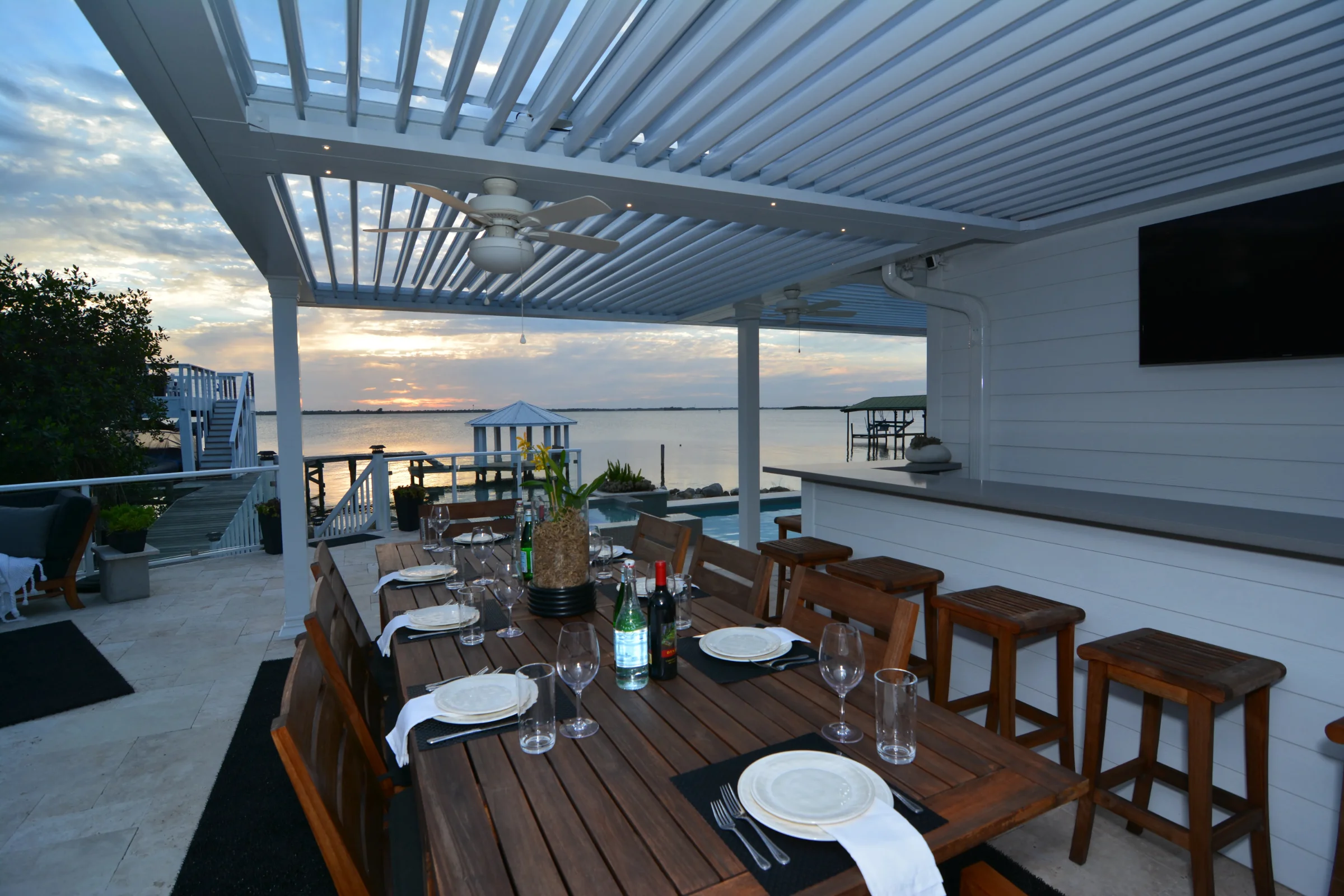
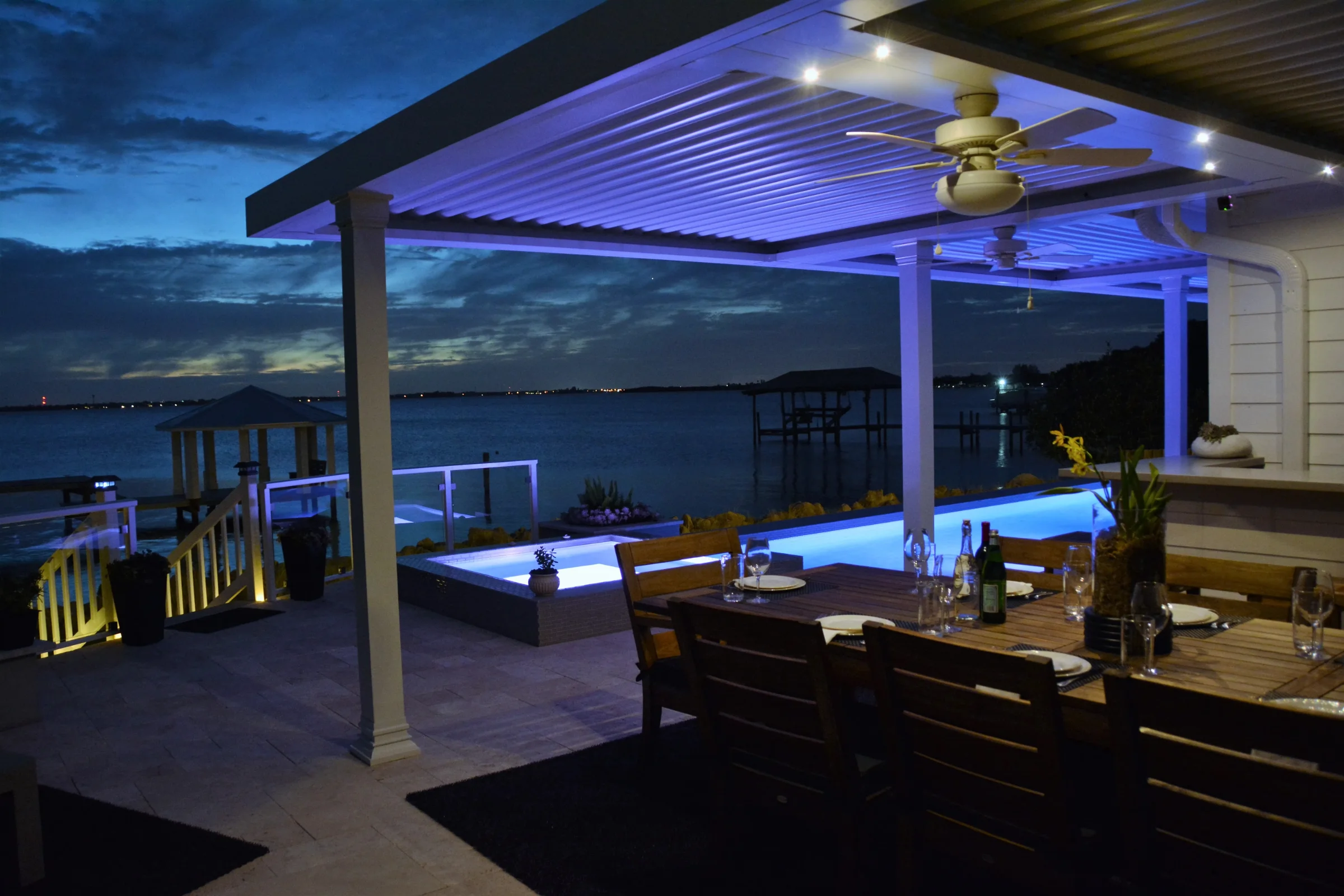
The reason an adjustable louvered roof outperforms a fixed cover in Juno Beach is the sea breeze. Rotating the blades lets you keep airflow moving through the space while cutting the direct sun, which is what makes a patio usable at two in the afternoon in July. Close the louvers and the roof sheds a summer downpour into the gutter system, so the furniture underneath stays dry. Open them in the evening and you have sky again.
Motorized side screens are a common addition, and they are worth being precise about. Comfort screens control insects, low sun and wind-driven rain, and they are a genuinely good investment on an exposed coastal lot. They are not the same thing as code-approved storm protection. If you want a screen that counts as opening protection, it must carry its own product approval and design-pressure rating for your opening, and that has to be stated in writing. Our overview of motorized hurricane screens in South Florida explains the difference in detail.
What drives the number on a Juno Beach quote
There is no honest single price for a coastal louvered pergola, because the same footprint can vary widely depending on what the engineering requires at your address. The variables that move the number most are size and span, whether the structure is freestanding or attached to the house, foundation work (coring through an existing pool deck costs more than pouring into open ground), the exposure category driving the structural spec, screens and lighting, and electrical runs for motors and fixtures.
What matters more than the headline figure is what is inside it. Ask whether structural engineering, permit fees, footings, motor and control wiring, and licensed installation are all included, or whether they arrive later as separate line items. Quotes that exclude those are not comparable to quotes that include them. Our louvered pergola cost guide breaks down how to read a quote line by line.
Permits and the approval path
A permanent louvered structure in Juno Beach is a permitted improvement. Expect signed and sealed structural drawings, a site plan showing setbacks, product approval documentation, and an electrical permit if the structure carries motors or lighting. If any part of the work sits seaward of the state Coastal Construction Control Line, a separate state-level review applies on top of the local permit, and that adds time — plan for it rather than discovering it.
Homes in nearby Jupiter and Palm Beach Gardens follow a similar path with their own local variations. Our Florida pergola permit guide covers the documentation you should expect to see.
Frequently asked questions
Do I need a permit for a pergola in Juno Beach?
Yes. A permanently anchored louvered structure requires a building permit, and a separate electrical permit if it includes motors, fans or lighting. Properties near the dune may also trigger a state coastal review. Your installer should handle the submittal and the inspections.
Can a louvered pergola handle oceanfront wind?
An engineered aluminum louvered structure can be designed for coastal Palm Beach County wind loads, but the design has to be site-specific. Ask for the signed drawing showing the design wind speed and exposure category used for your address, plus the product approval number for your configuration.
Will outdoor lighting under the pergola violate turtle lighting rules?
Not if it is designed correctly. Shielded, downward-directed, long-wavelength fixtures with zone control are the standard approach on this coast. Confirm current requirements with the town before specifying fixtures, particularly for anything visible from the beach.
How much maintenance does a coastal pergola need?
Regular freshwater rinsing of the frame, louvers and any screen tracks, plus periodic checks on fasteners, drainage and motor housings. Salt exposure means a shorter interval than an inland home, but the work itself is simple.
Freestanding or attached to the house?
Both work. Attached structures tie into the roofline and read as an extension of the house; freestanding structures give you flexibility on placement and avoid modifying the existing roof. The decision is usually driven by setbacks, roof condition and where the shade is actually needed at the time of day you use the space.
Building an outdoor room in Juno Beach
The right structure here is the one engineered for a coastal exposure, documented with real product approvals, and detailed for salt. Explore the Pergola X louvered roof system and the Cabana X structure, or request a consultation and we will walk your property, take the exposure and setbacks into account, and put a real number in front of you.