
Vacation Rental Pergola Guide: Covered Outdoor Space That Books More Nights in South Florida
South Florida short-term rentals compete on photographs and on reviews, and both are won outdoors. A guest booking a week in Fort Lauderdale or Delray buys a pool and a patio, not a living room. The problem is simple. An uncovered pool deck sits unusable from late morning to late afternoon for much of the year, then again the moment a storm cell arrives. A vacation rental pergola is one of the few improvements that changes the listing photograph, the guest experience and the number of bookable hours in a day at the same time.
This guide covers what makes an operable louvered roof suit rental property specifically, the operational realities of a structure guests will control, and the regulatory questions to settle first.
Why the outdoor space decides the booking
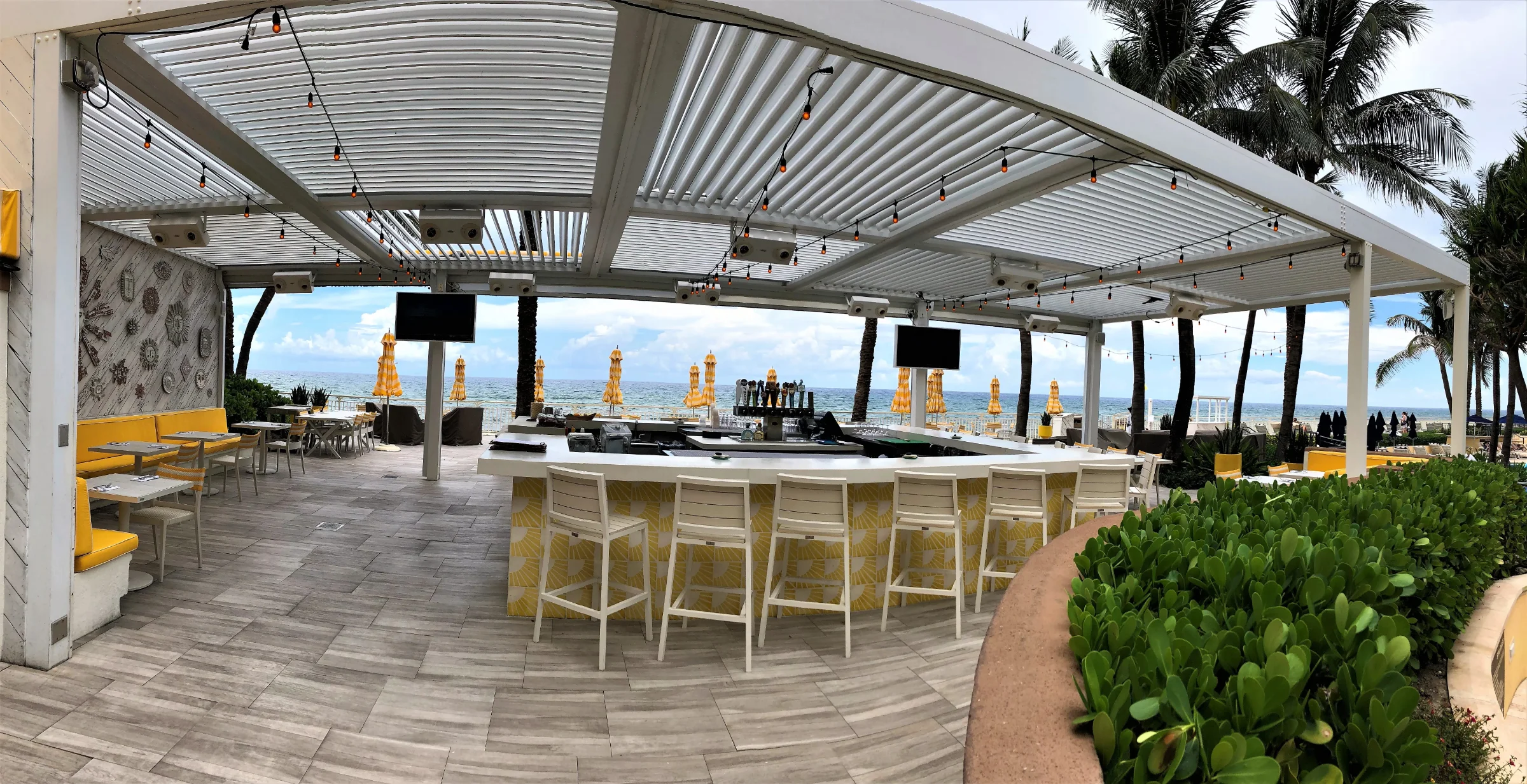
Look at how South Florida rentals present themselves. The hero image is almost always the pool, the deck or the water. Guests filter on those amenities. A covered dining area photographs as usable space; an exposed slab does not.
The operational effect runs larger than the visual one. An uncovered deck in July is pleasant early and late, and hostile in between. Shade returns the middle of the day. Closed blades hold the space through a rain shower rather than sending a family of six indoors for the afternoon. For a property competing on reviews, “we could still eat outside when it rained” is the detail that becomes a five-star write-up.
It also extends the shoulder season. The months when an uncovered property feels marginal are exactly when a covered, shaded outdoor room feels fine.
What a vacation rental pergola has to survive
A rental structure lives a harder life than the same structure at an owner-occupied home. Specify accordingly.
It will be operated by people who have never seen one. Guests press buttons. The control interface must read as obvious and the failure modes must stay benign. A simple wall control with a few preset positions beats an app that needs onboarding.
Nobody is watching it. Between stays, and during a mid-week storm, nobody is there to close anything. That argues decisively for an aluminium system with integrated rain and wind sensing over fabric someone must retract by hand. Our guide to pergola automation and smart home control covers how sensor-driven closure is configured.
Maintenance has to be near-zero. An owner living two states away cannot treat timber or replace fabric. A powder-coated aluminium structure needs no annual refinishing, which is why so many rental owners end up replacing a wood pergola with aluminium rather than maintaining one.
Salt air is relentless. On a barrier island or a canal-front lot, finish quality and fastener specification decide whether a structure still looks good in year eight or looks tired in year three.
Where to put a vacation rental pergola
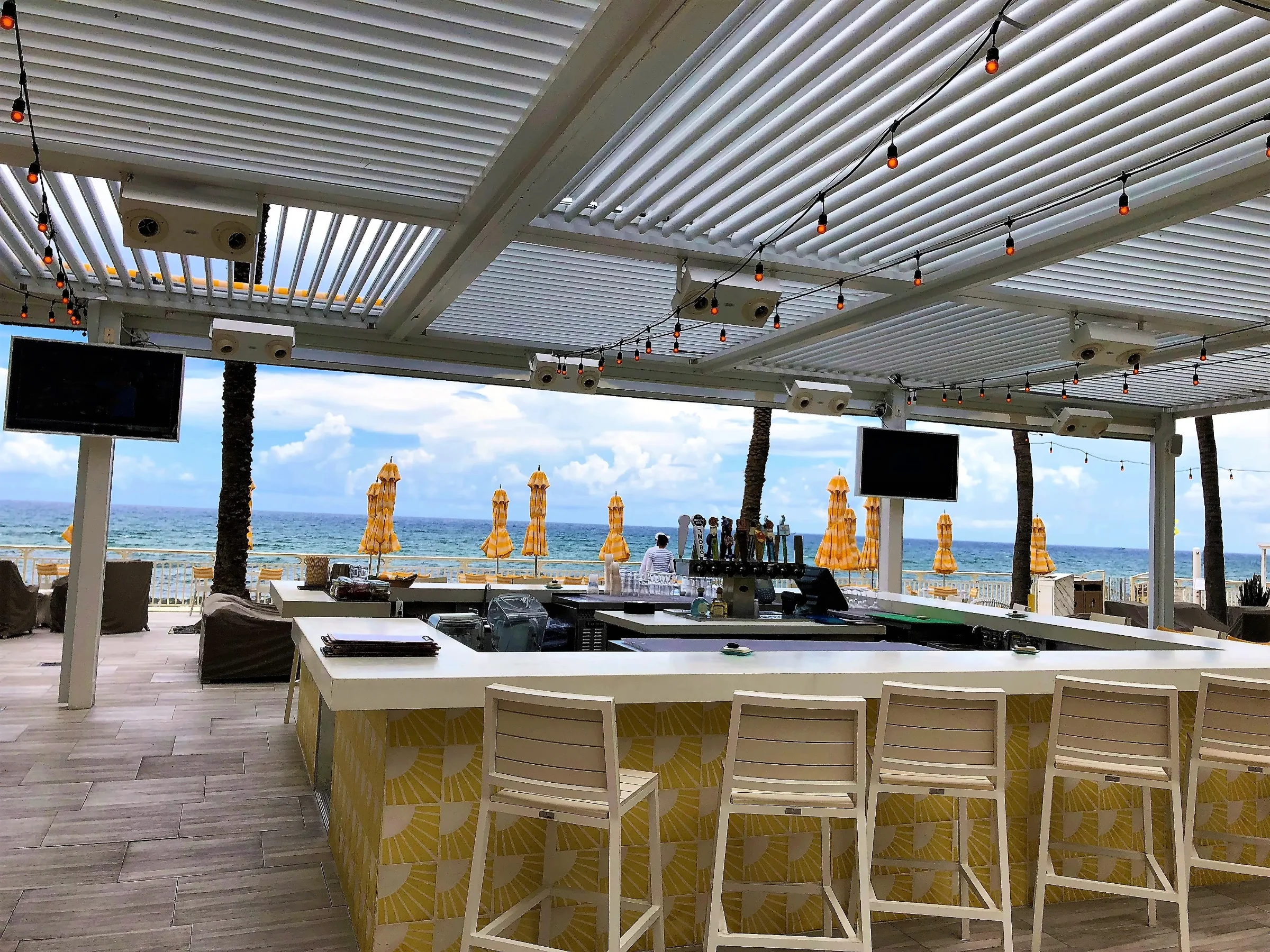
Most rental properties gain more from a covered dining and lounge zone set back from the pool than from a structure over the water. Poolside furniture gets wet and stays wet. A dining table needs to stay dry. So shade a table, a seating group and a serving surface, and leave the pool open to the sun guests came for. That serves the listing better than covering the water.
Where a property already has a summer kitchen, covering it usually delivers the most value. It makes the grill usable in rain and shades a counter that otherwise gets too hot to touch. Our guide to outdoor kitchen pergolas in South Florida covers that specific case.
Rooftop terraces on townhouses and small multi-unit buildings offer a distinct opportunity and a distinct engineering problem — see rooftop pergolas in South Florida for how load paths on an existing structure are handled.
Regulatory questions to settle first
Short-term rentals sit in a more complicated regulatory position than owner-occupied homes. Resolve these before design.
Short-term rental registration. Many South Florida municipalities require registration or licensing, sometimes with inspections. A new structure can trigger a re-inspection, so timing matters.
Zoning and coverage. Setback and impervious-area limits match those for any residence. A property already carrying a pool, deck and driveway may have little allowance left. Our guide to Florida pergola permits and the associated contractor vetting questions cover the sequence.
Pool barrier compliance. If a column or a screen alters the pool barrier, address it in the same permit. On a rental property, barrier compliance carries extra weight.
Insurance and disclosure. Tell your carrier. A permitted, engineered structure makes for a straightforward conversation. An unpermitted one becomes a problem at claim time, especially after a named storm.
On the structural side, the framing matches any other South Florida property. A Florida Product Approval or Miami-Dade Product Control approval confirms a product met a standard within the sizes and pressures it was tested at — it is not an approval of your structure. The building department reviews signed and sealed site-specific engineering for your address. ASCE 7 sets the design pressures, as adopted by the Florida Building Code. Confirm any contractor through the Florida DBPR licensee search.
Thinking about the return on a vacation rental pergola
We will not invent numbers for your property, and you should distrust anyone who does. The levers are identifiable, though, and you can apply your own figures. A vacation rental pergola supports a higher nightly rate, lifts occupancy in shoulder months, improves review scores that feed platform ranking, and costs less to maintain than timber or fabric.
So price the structure, then work out the nightly-rate increase or the extra booked nights needed to recover it over a realistic horizon. For most owners that arithmetic persuades far better than a generic return figure. Our cost guide explains what sits inside a South Florida price, and financing options are available if the capital timing is the constraint.
Frequently asked questions
Will guests damage a vacation rental pergola?
Normal use will not damage an aluminium structure. The control system carries the real exposure, which is why a fixed wall control with presets beats a removable remote that walks off between stays.
What happens during a storm if the property is empty?
An engineered aluminium structure handles the wind pressures at your site and stays put. With sensor-driven automation the blades move to their storm position with nobody present. Adding motorized screens gives further protection to the space beneath.
Does it work for a condo or a managed community?
Often, though association approval comes first and frequently runs stricter than the municipality. Submit the engineered drawings to the architectural review board early, because that timeline is usually the long pole.
How long does installation take?
The build itself is short. Permitting is the variable, and it differs substantially between jurisdictions. For a rental the practical question is which weeks to block, so raise the booking calendar at the start.
If you own a rental anywhere from Miami to the Treasure Coast and want to know what fits the lot, get in touch with our team or see the Pergola X and Cabana X systems.