
Grill Under a Pergola in Florida: Clearance, Ventilation and Fire Code
Almost every outdoor kitchen we build in South Florida ends up with a grill under a pergola. Almost every homeowner then asks the same question: is that actually allowed? The honest answer is that it depends on three things — what fuel you burn, how far the cooking surface sits from anything combustible, and how much open sky you leave above the flame. Get those three right and a grill under a pergola is safe, code-compliant and genuinely better than an unshaded grill in a Broward August. Get them wrong and you have created a heat trap over your head.
This guide walks through the clearances, the ventilation logic and the code sections that actually apply in Miami-Dade, Broward and Palm Beach counties. It reflects what our crews and the plans examiners we work with ask for, rather than what a manufacturer brochure claims.
Why a grill under a pergola behaves differently from a grill in the open
A gas grill running at full output produces a surprising amount of energy. A four-burner unit sits between 48,000 and 60,000 BTU per hour. A searing side burner can add 15,000 more. In the open, that plume rises and disperses within a few feet. Under a solid roof, it hits the underside, spreads sideways and lingers.
An adjustable louvered roof changes the picture, because you can open the blades and let the plume leave. That is why a grill under a pergola with operable louvers differs from one under a fixed patio cover. The louvers are not decoration here. They are the ventilation path.
Open louvers are not a licence to ignore clearance, however. Grease-laden vapour still deposits on whatever sits above it, and radiant heat still reaches the framing. Both problems get solved with distance rather than with good intentions.
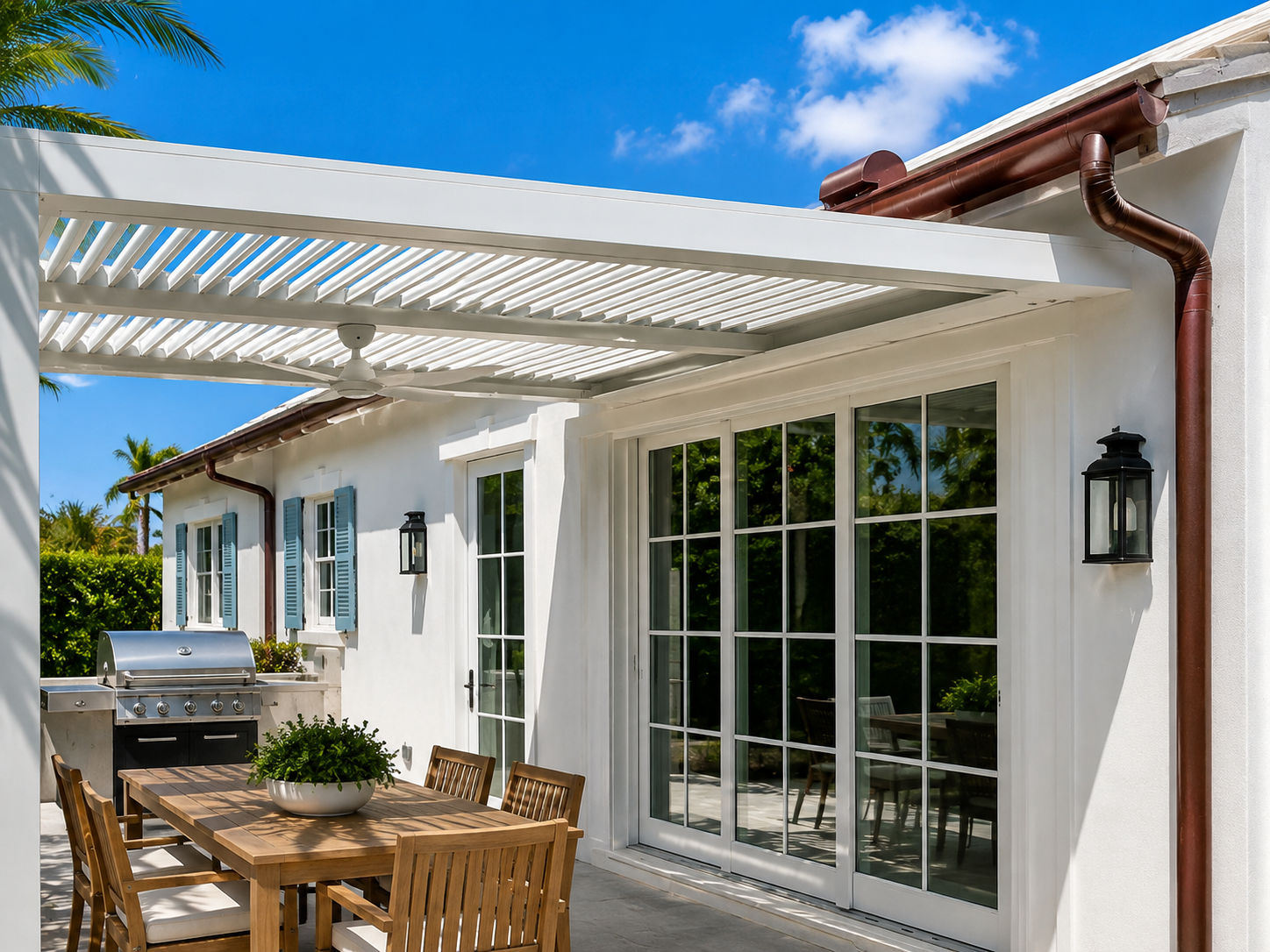
Clearance numbers for a grill under a pergola
Start with the grill manufacturer’s installation manual, because that document governs. Nearly every listed residential gas grill carries a tested clearance to combustible construction. It is stated as inches to the sides, to the rear and above the cooking surface. Those numbers come from the listing agency, and a plans examiner will ask to see them.
For aluminum structures the calculus is easier, because aluminum is non-combustible. Even so, we design a grill under a pergola with at least 36 inches of vertical space above the closed grill lid. In practice we prefer 42 to 48 inches. Televisions, timber trim, fabric shades and speaker enclosures all stay well outside that envelope.
Where the real risk sits
The risk is rarely the aluminum itself. Instead it is the things people add after the structure is finished. A retractable fabric screen dropped directly beside a lit grill, a bamboo privacy panel, a stack of pool towels on the counter, a propane cylinder stored inside a closed cabinet without ventilation — those are the failure points we actually see. Store cylinders upright, outdoors and in a ventilated enclosure, and never inside a sealed island.
Fuel choice changes the answer for a grill under a pergola
Natural gas is the cleanest option, because there is no cylinder to store and the plume is relatively dry. If your street has gas service, run a dedicated line with an accessible shutoff and have a licensed plumber pull the permit.
Propane is the most common choice in South Florida because gas mains are patchy. Handle the cylinder in line with NFPA 58, which is the standard behind most local LP gas requirements. Keep the cylinder outside the cabinet unless that cabinet is purpose-built and vented at both the top and the bottom.
Charcoal is the one we push back on. A charcoal grill under a pergola throws embers and produces far more particulate. It also deposits a sticky residue on the blades that is genuinely difficult to remove. We will build it if a client insists, but we say plainly that it will discolour the powder coat over time and that no warranty covers soot staining. That conversation is worth having before the deposit rather than after.
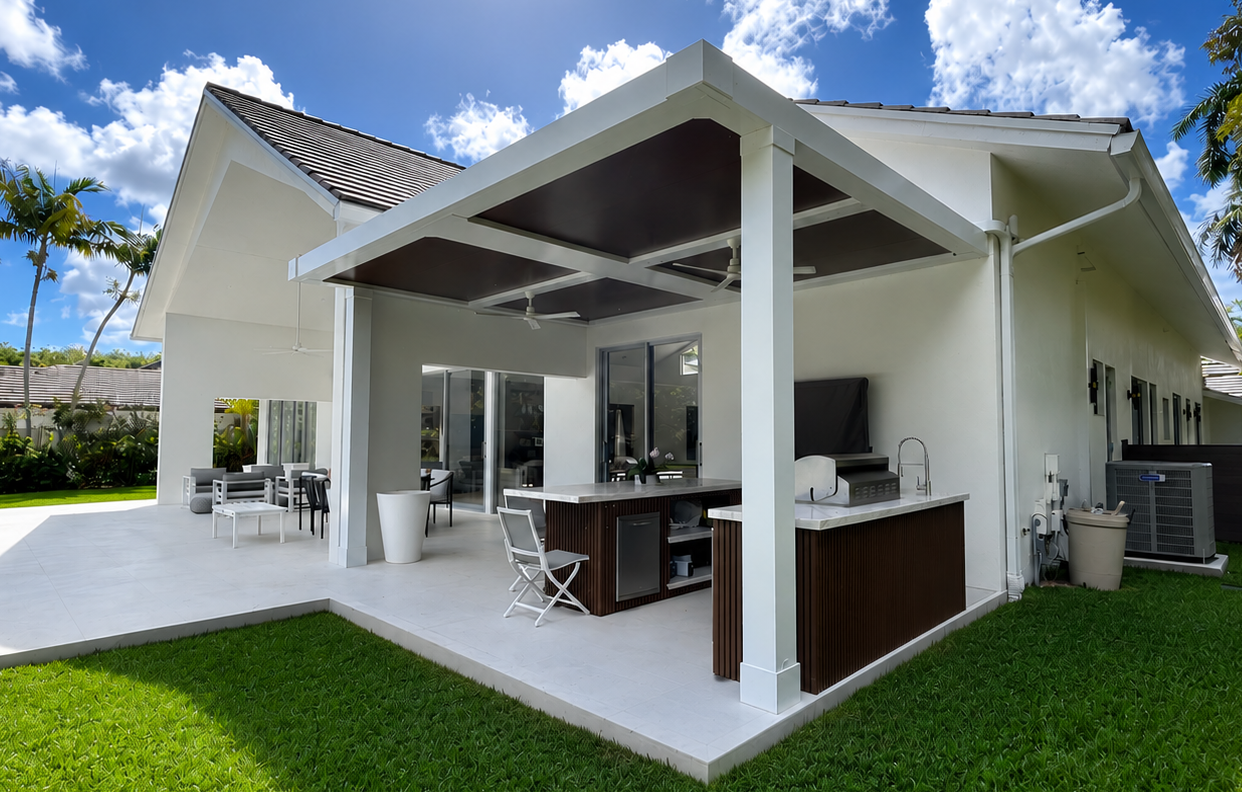
Ventilation: hoods, louvers and the outdoor hood myth
Homeowners often ask for a vent hood. Under an operable louvered roof, a hood is usually unnecessary and sometimes counterproductive. A residential outdoor hood needs a real duct run, a make-up air path and a cleaning regime. If the louvers open, there is very little left for it to do.
A hood earns its place in two situations. First, when the cooking area sits under a solid roof or a deep soffit with no operable opening. Second, when the grill is recessed into an alcove where the plume cannot escape sideways. In both cases the hood becomes mechanical equipment and needs its own permit and inspection.
The practical alternative is simpler. Open the louvers before you light the grill, cook, then leave them open for ten minutes afterwards. Our automation and smart-home controls can put that on a single scene button so nobody has to remember.
What Florida code actually says about a grill under a pergola
No single line in the Florida Building Code says that you may not put a grill under a pergola. What exists instead is a set of overlapping requirements. The Residential volume governs the structure and its attachment, the Fuel Gas volume governs the gas line and appliance connection, and the Mechanical volume governs any hood you install. Local amendments then layer on top, and Miami-Dade and Broward each add their own.
The structure itself needs a permit regardless of the grill. If yours attaches to the house, the attachment detail and the uplift path both get reviewed. Our guide to the Florida pergola permit process covers what the submittal package contains, and the footing and mounting guide explains why the connection detail matters more than the beam.
Product approval is not structural approval
This point gets misrepresented constantly, so we will state it directly. A Florida Product Approval or a Miami-Dade Notice of Acceptance confirms that a product met a standard within the sizes and pressures it was tested at. It is not an approval of your structure at your address. Every StruXure installation we build is engineered for its specific site, span and wind exposure. That site-specific engineering is what the building department reviews. You can look up any product on the Florida Product Approval search and confirm the tested limits yourself.
Designing the outdoor kitchen around a grill under a pergola
Layout decides how comfortable the space feels. Put the grill on the downwind edge. The prevailing easterly breeze then carries smoke away from seating. Leave at least 24 inches of landing counter on both sides of the cooking surface. Keep the refrigerator away from the grill. Compressors work hard enough in a Florida summer without radiant heat beside them.
Drainage matters too. Grease and rain both need somewhere to go, and a counter that slopes back toward the house becomes a maintenance problem forever. Our outdoor kitchen pergola guide covers the counter and cabinet decisions in more depth.
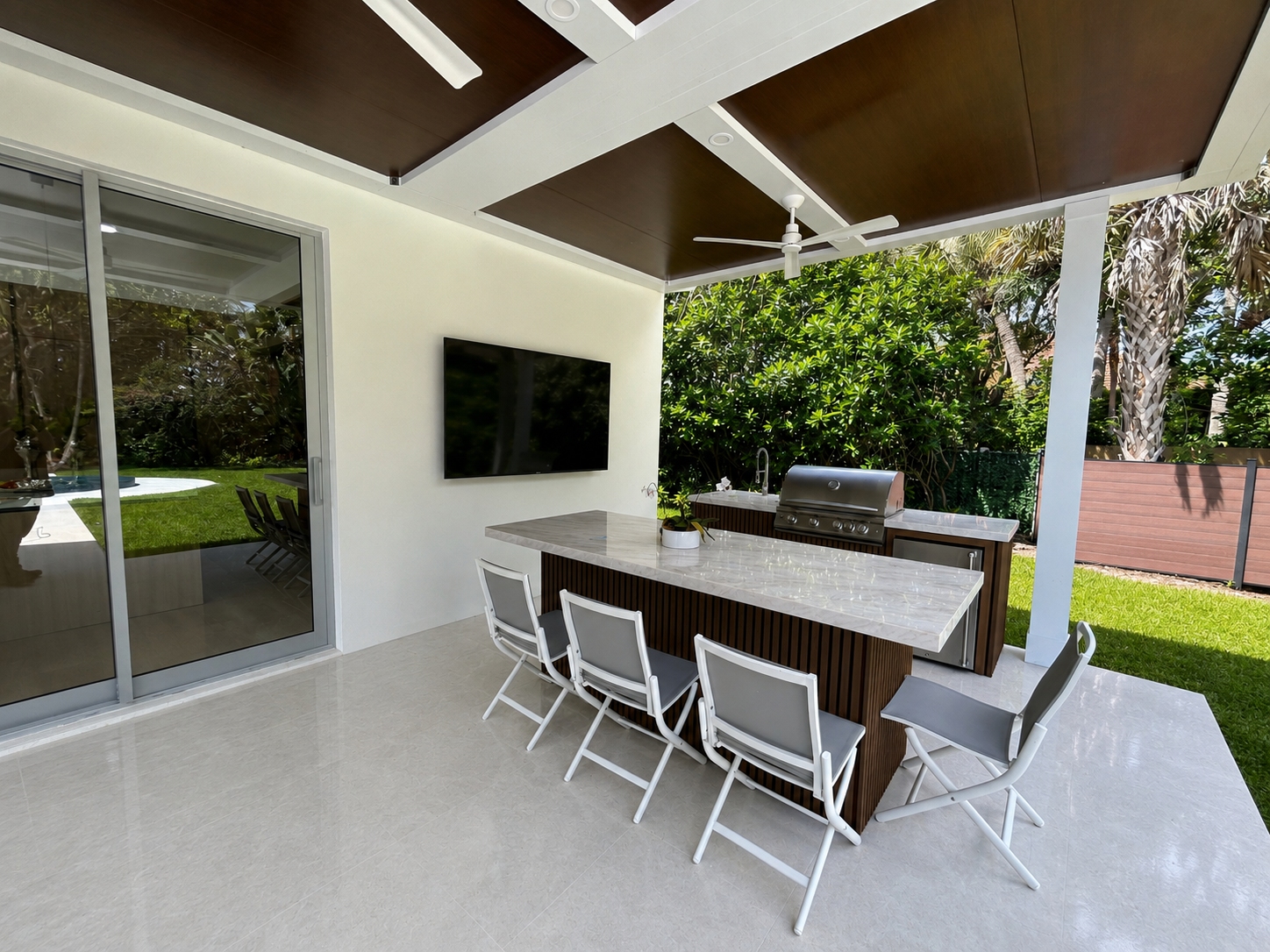
Maintenance for a grill under a pergola
Wipe the blades directly above the cooking zone two or three times a season with mild soap and water. Grease that sits through a summer bakes on. Once it has cured into the powder coat finish, removal takes far more aggressive cleaning. Rinse with fresh water afterwards, particularly within a mile or two of the ocean. Salt and grease together are worse than either one alone.
Frequently asked questions
Can I put a grill under a pergola attached to my house?
Yes, provided the clearances above are respected and the attachment is engineered. An attached structure needs a continuous load path from the roof back into the house framing, which the permit drawings will show.
Do I need a hood over a grill under a pergola?
Usually not, if the roof has operable louvers you can open while cooking. A hood becomes necessary when the area above the grill is solid and the plume has no escape route.
Will the heat damage the aluminum?
Aluminum is non-combustible and will not ignite. Sustained radiant heat at close range can still discolour a powder coat finish, which is exactly why the 36-inch minimum vertical clearance matters.
Can I use a charcoal grill under a pergola?
You can, but we advise against it. Ember throw and soot deposition are real, staining is likely, and no finish warranty covers it.
Talk it through before you build
A grill under a pergola is one of the most-used parts of any outdoor living space in South Florida, so it is worth designing properly rather than retrofitting later. If you are planning an outdoor kitchen, bring the grill model number to the first conversation, because the manual’s clearance table shapes the whole layout. Talk to our team and we will lay the design out around it.