
Ceiling Fans Under a Louvered Pergola in South Florida
A ceiling fan under a pergola is the cheapest comfort upgrade available in South Florida, and it is also the one most often specified badly. An indoor fan will rust out in a season. An undersized one will move nothing. A fan hung from the wrong member will vibrate the louvers every time it runs. Below is how we select and mount fans under a louvered roof, and what the code actually requires outdoors.
Why a ceiling fan under a pergola does more than a fan indoors
Indoors, a fan mostly redistributes conditioned air. Outdoors it does something more useful: it raises the rate at which sweat evaporates off your skin. That effect is worth several degrees of perceived temperature, which in July is the difference between using the space and abandoning it.
Air movement also suppresses the still, humid pocket that forms under a closed louvered roof. Consequently the surface stays drier, mildew has less to work with, and mosquitoes struggle to hold position. In short, the fan is climate control, not decoration.
Wet-rated, damp-rated, and why the difference matters
Fans carry a UL listing for a specific environment. A damp-location fan suits covered areas that never see direct water. A wet-location fan seals against direct exposure, including wind-driven rain.
Under an operable louvered roof, the honest answer is that your space is sometimes covered and sometimes open. Because the louvers rotate, rain reaches the underside whenever they open, and wind-driven rain reaches it even when they close. Therefore we specify wet-rated fans as the default and treat damp-rated as the exception.
Beyond the listing, look at the materials. Sealed motor housings, marine-grade or ABS blades, and stainless or coated hardware all matter within a few miles of salt air. Similarly, an all-weather finish that carries a coastal warranty is worth the premium. Our notes on galvanic corrosion apply to fan hardware exactly as they do to structural fasteners.
Mounting a ceiling fan under a pergola to a louvered roof
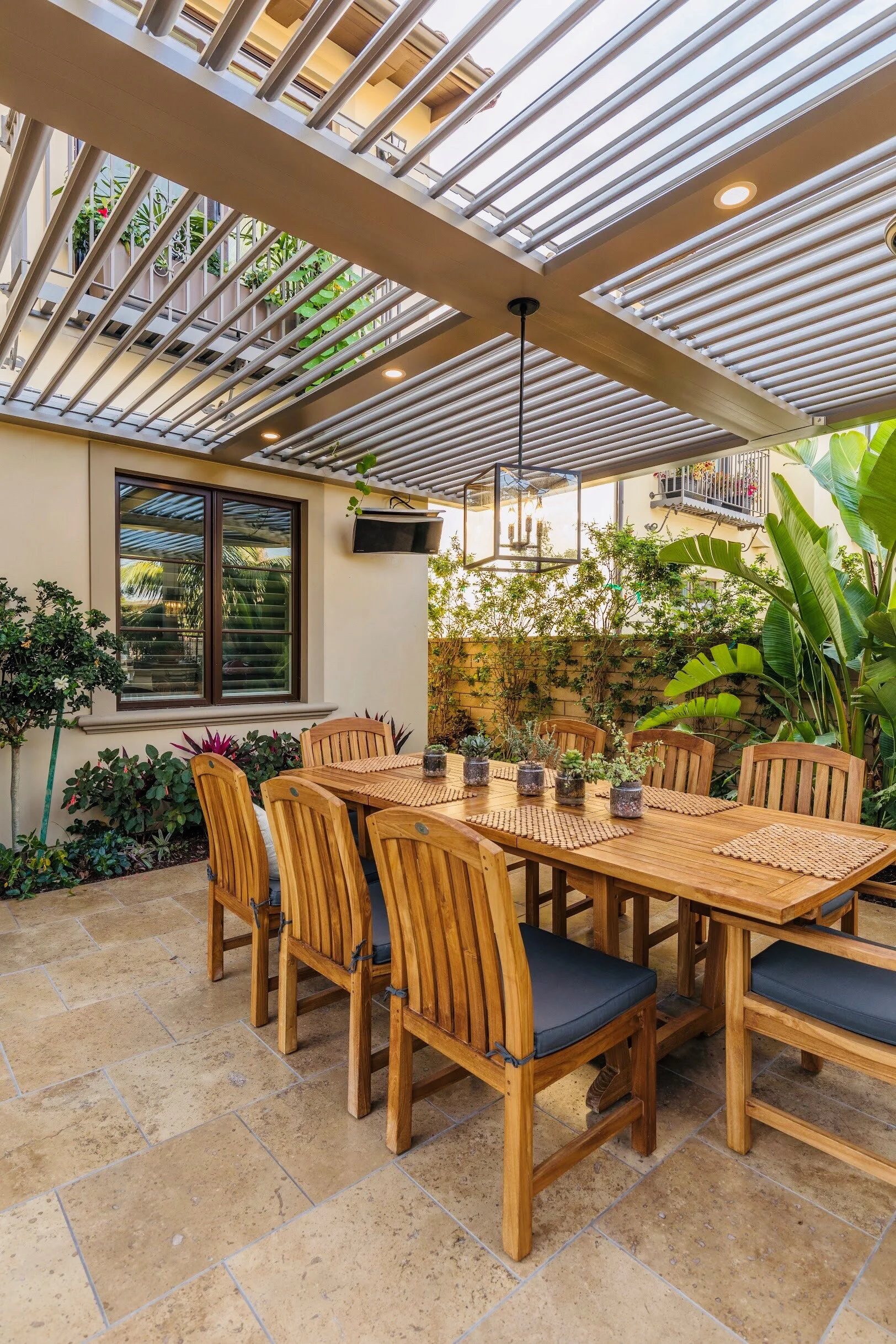
This is where a louvered system differs from a solid patio cover. The louvers themselves rotate and carry no point load, so nothing hangs from them. Instead the fan must attach to a structural member.
The fan beam
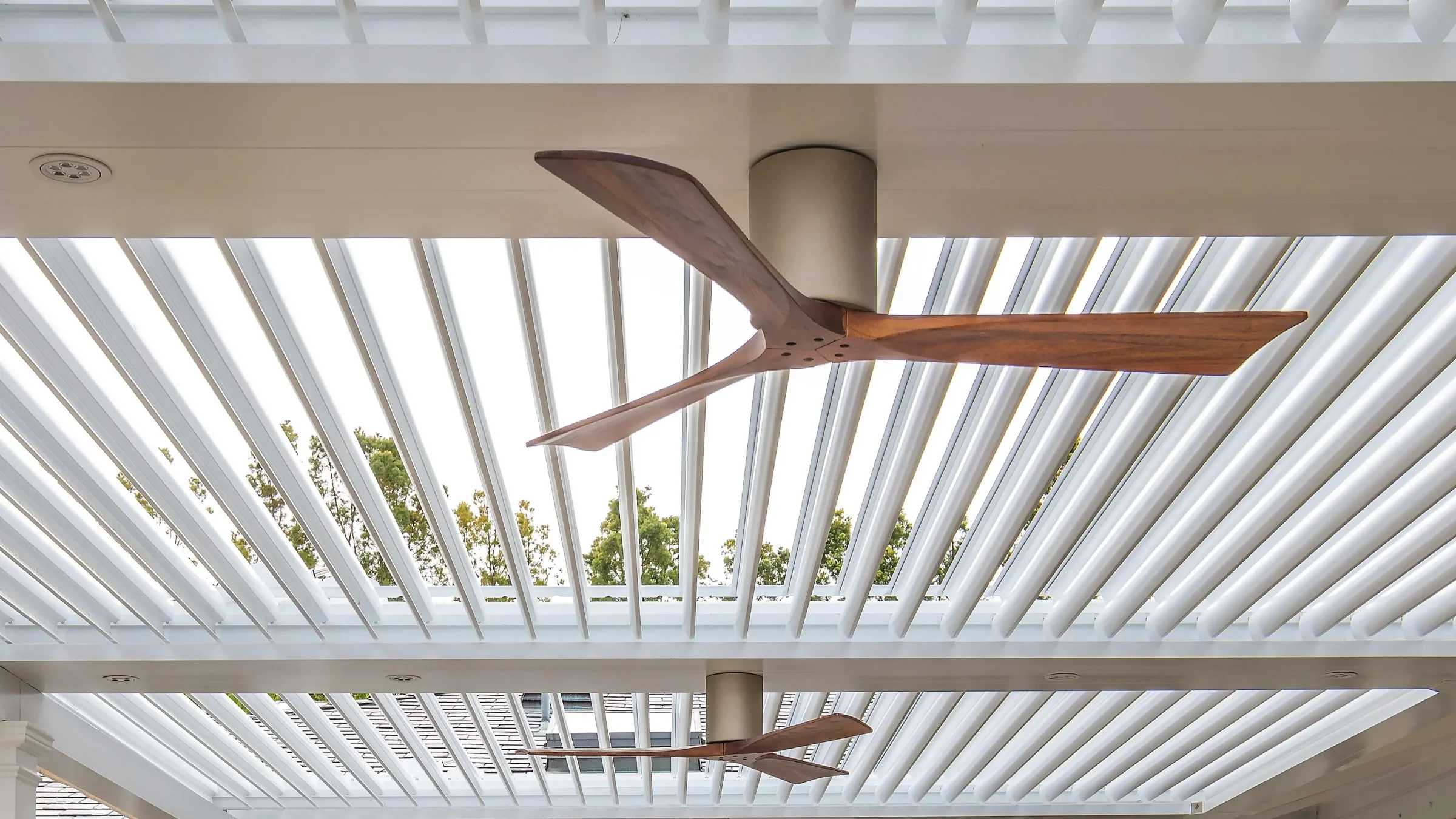
StruXure systems accept a dedicated fan beam: a structural cross member that we size and place to carry a fan, with the wiring chase already inside it. Because we design it in from the start, you get no exposed conduit and no improvised bracket. Moreover, the beam position determines where the fan can go, which is why this decision belongs in the design phase.
Retrofitting is possible but constrained. The fan has to land on an existing beam, the electrical has to reach it, and the box has to carry a fan-support listing rather than a luminaire listing. That last point is a common code violation. A standard outlet box will not hold a fan, and an inspector will fail it.
Blade span, mounting height and actual airflow
Bigger is usually better outdoors. Wind dilutes the column of air a fan produces, so a 52-inch fan that feels strong indoors can feel weak on an open patio. For most residential bays we look at 60 to 72 inches, and for long rectangular spaces we prefer two fans over one large one.
Height changes the result as much as span. Blades want to sit roughly eight to nine feet above the floor for good coverage. Above that, the airflow spreads and thins; below it, the sweep becomes a hazard. Downrods let you tune this, though a longer rod adds leverage and demands a properly rated mount.
Manufacturers publish airflow in cubic feet per minute and efficiency in CFM per watt. ENERGY STAR lists both for certified models, which makes comparison straightforward. Notably, blade pitch and motor type affect the number far more than blade count does.
What a hurricane means for an outdoor fan
We engineer the louvered structure itself for the wind loads at your specific address. The fan is not part of that engineering. It hangs underneath as an appliance, so treat it the way you treat any other loose item before a named storm.
Most manufacturers expect you to remove the fan, or at minimum the blades, ahead of a major event. Our summer shutdown checklist covers the sequence. Meanwhile, if you want the space usable through squall lines rather than just fair weather, motorized hurricane screens do far more for you than any fan will.
Choosing a ceiling fan under a pergola: a short checklist
Confirm the UL wet-location listing first, since everything else is moot without it. Next, verify that a fan-rated box and a structural member exist at the intended location. Then size the blade span to the bay, not to the room you imagine. Finally, check the control path.
Controls deserve a note. A fan on a wall switch is fine, but a fan integrated into the same system as the louvers and lights is better. Our guide to pergola automation and smart home control explains how the wiring runs.
Frequently asked questions
Can I add a ceiling fan under a pergola after installation?
Often yes, provided a suitable structural member sits where you want the fan and the electrical run can reach it. Nevertheless, adding a fan beam later is far more disruptive than specifying one at design time.
Do I have to remove the fan before a storm?
Follow the fan manufacturer’s guidance, which usually calls for removing the blades or the whole unit ahead of a major hurricane. The pergola stays; the appliance comes down.
What size fan suits a large covered area?
For spans beyond roughly sixteen feet, two properly spaced fans outperform one oversized unit. Two moderate fans also give you redundancy and a more even column of air across seating.
Will a ceiling fan under a pergola help with mosquitoes?
Yes, to a degree. Mosquitoes are weak fliers and steady air movement makes it hard for them to land, so a fan measurably reduces bites. Still, screens remain the reliable answer if the area backs onto standing water.

Running cost, noise and the things nobody mentions
Outdoor fans run for long stretches in South Florida, so efficiency compounds. A DC motor typically draws a fraction of the wattage of an older AC unit at the same airflow, and it also offers finer speed control at the low end. Over a decade of daily use, that difference is real money.
Noise is the other overlooked factor. A fan that hums pleasantly indoors can sound intrusive outdoors, where no carpet or upholstery absorbs it. DC motors are generally quieter, and a properly balanced blade set matters more than either.
Vibration deserves attention on a louvered structure specifically. Because the frame is aluminum and relatively rigid, an out-of-balance fan transmits through the beam and can rattle the louver blades audibly. Balancing kits ship with most fans and take ten minutes to apply, yet installers routinely skip them.
Lastly, check the remote or control protocol before buying. A fan locked to a proprietary handset will never integrate with the rest of the system, whereas one that speaks a common protocol drops straight into the same schedule as the louvers and the lights.
Design the fan in, not on
The best outcome comes from deciding fan positions while the structure is still on paper, because the beam layout, the wiring chase and the finished height all follow from it. Contact StruXure South Florida and we will lay out the bays, the beams and the fan positions together before the shop cuts a single extrusion.