
Employee Break Area Shade for Florida Warehouses and Industrial Sites
Employee break area shade is the cheapest piece of heat-safety infrastructure a Florida warehouse can buy. It is also the last thing anyone budgets for. Crews take their fifteen minutes in a forklift cab, a stairwell, or the shadow beside a trailer. Meanwhile the yard sits at 95 degrees with a UV index in double digits. So the rest break does almost nothing for core temperature.
So the question is not whether workers need somewhere to cool off. It is what that somewhere has to survive. Eight months of direct sun. An afternoon storm most days in summer. And a hurricane season running June through November.
Why employee break area shade matters on a Florida industrial site
Heat is not a comfort problem in a distribution yard. It is a productivity and liability problem. OSHA runs an active enforcement programme covering outdoor and indoor heat. Its guidance treats shade and cool water as a basic control rather than a perk. You can read the agency’s overview on the OSHA heat exposure page, which sets out the rest, water and shade approach most safety managers already recognise.
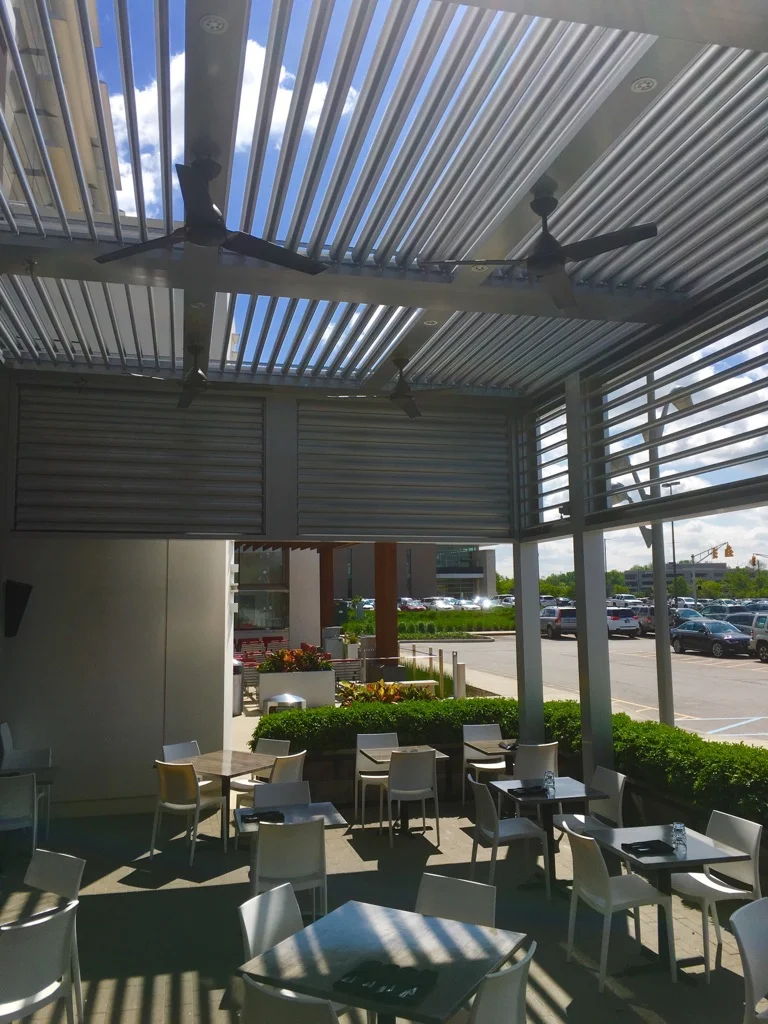
A break is only as good as the environment you take it in. So a canvas pop-up over hot asphalt does very little. Radiant heat comes off the paving, the tent traps it, and the air underneath barely moves. A permanent structure with an open, ventilated roof performs differently. That difference shows up in how quickly people are ready to work.
What OSHA expects from an outdoor rest area
Nothing in the guidance names a product. Instead it describes an outcome: a place that blocks direct sun, allows air movement, sits close enough that people will actually use it, and offers seating and water. Therefore the practical failure mode is distance. If the shade sits 200 yards from the dock doors, a fifteen-minute break becomes a walk. Then crews stop bothering.
Site the structure where the work happens. Then make it large enough that a full shift change does not have to queue for a seat.
Employee break area shade that survives a Florida summer
Fabric shades and cantilevered sails look inexpensive on a quote. However, in South Florida they tend to become a recurring line item. UV degrades the fabric, afternoon storms load it, and someone has to take it down before every named storm. After two or three replacement cycles the “cheap” option costs more than an aluminium structure that stays put.
An extruded aluminium louvered roof solves several problems at once. The louvers close to shed rain, so a downpour does not end the break. They also open to vent hot air, which matters far more than most people expect. A sealed solid roof over a hot slab simply traps heat underneath. And the aluminium itself does not rot, rust through, or need repainting the way a steel canopy does in salt air. Our guide to how aluminium behaves in Florida heat covers the material side in more depth.
Wind ratings, permits and the engineering behind a commercial canopy
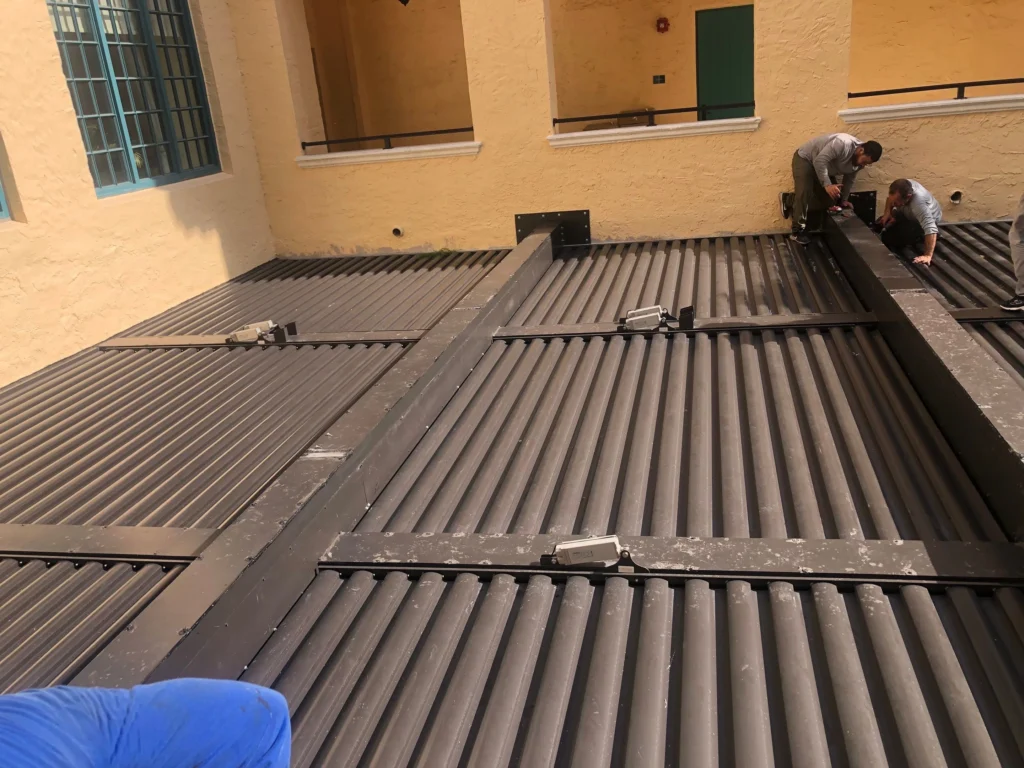
Every permanent structure on a commercial site in Florida needs a permit, and permitting means engineering. This is where a lot of buyers get caught out. A product approval number describes a product tested in a lab. It does not describe your slab, your soil, your exposure category, or the distance from your building.
Consequently every StruXure build gets engineered for its own address. An engineer sizes the footings, the anchors and the hold-downs for that specific site and signs the drawings that go to the building department. A yard on an open industrial parcel near the coast carries very different loads from a courtyard tucked between two buildings, even in the same city. We walk through the process in what a Florida pergola permit actually involves.
Ask any vendor for the engineering package before you sign. If they offer a catalogue number instead of stamped drawings for your address, that structure will stall at plan review.
Sizing employee break area shade for shift changes
Start from headcount at peak overlap rather than average headcount. A facility running 40 people across two shifts may put 60 bodies in the break area at changeover. Then add tables, circulation, and a route that avoids walking behind a reversing truck.
Multiple smaller structures often beat one large one. Two 20-by-20 canopies at opposite ends of a yard cut walking time in half, and they let you phase the spend across two budget years.
Power, lighting and fans in a break area
Once you have a roof, the rest is straightforward and worth doing at the same time. Run conduit during construction rather than surface-mounting it later. Fans move air across skin and speed evaporative cooling. So they beat another ten feet of shade. Lighting matters for night shifts, and outlets matter because people charge phones and scanners.
A fan-rated beam has to carry the dynamic load, so specify it up front instead of adding a fan to a structure that was never designed to hold one.
What employee break area shade costs to own
Compare total cost of ownership rather than the sticker on the quote. A fabric structure has a low purchase price and a short life. Add seasonal takedown labour and replacement fabric every few years. An engineered aluminium structure costs more once, then sits there.
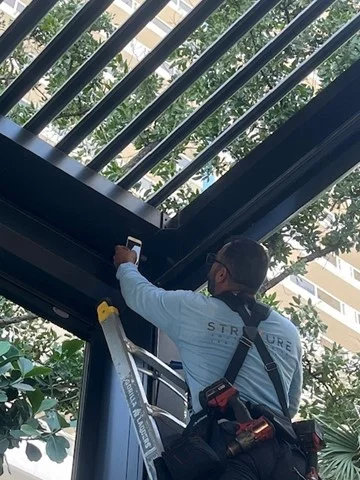
Also check what the quote includes. Many vendors price the structure alone. Engineering, permitting, footings, rough-in and installation then land on you. Our commercial pergola cost guide breaks down what belongs in a genuine apples-to-apples comparison.
Frequently asked questions
Does employee break area shade require a building permit in Florida?
Yes. Any permanent structure needs a permit. The building department will also want stamped engineering for your address. Temporary tents sometimes avoid this, but they also blow away.
How big should a break area be for 30 workers?
Size it from peak overlap, not headcount. Thirty workers across overlapping shifts often means 45 people at changeover. Plan seating and circulation for that peak.
Can a louvered roof stay up through hurricane season?
An engineered aluminium louvered structure stays anchored year-round. That is the whole point of engineering it for the site. Fabric and tent structures come down before every named storm.
How long does installation take on a working site?
Design and permitting take the bulk of the calendar; the physical install is short by comparison. Timelines vary by jurisdiction and scope. So ask for a schedule specific to your county.
Talk to us about your site
We build engineered, permitted commercial louvered structures across South Florida. Licensed, factory-trained crews install them. Want to size and price a break area? Get in touch, and we will start from your site conditions rather than a catalogue.