
Re-Roofing a Florida Home With an Attached Pergola: Sequence, Flashing and Warranty
Sooner or later every South Florida house needs a new roof. If a louvered pergola sits on the fascia or the wall below it, that project suddenly involves two trades instead of one. A pergola roof replacement sequence handled badly produces leaks, voided warranties and an argument about which contractor caused what. Handled well, it costs almost nothing extra.
This guide covers who goes first and what happens at the flashing. It also explains how Florida code and warranty terms shape the decision.
Why a pergola roof replacement needs planning at all
An attached louvered pergola transfers load into the host structure. In South Florida engineers design that connection for uplift. Expect through-bolts, structural blocking or a ledger anchored into the tie beam. A few lag screws into the fascia board will not do. Consequently the roofer cannot simply work around it the way they would work around a gutter.
Meanwhile the roof assembly itself has changed. Florida now requires a secondary water barrier on many re-roofs. Underlayment and fastening schedules are also far more prescriptive than they were twenty years ago. As a result the layers at the pergola connection are thicker and less forgiving than whatever was there originally.
Wall-mounted versus fascia-mounted: which connection you have
Before anything else, establish how the structure attaches. The answer changes the whole sequence.
A wall-mounted pergola ties into the masonry wall below the roof line, usually into the concrete tie beam. This is the friendlier case. The roofer works above the connection and rarely disturbs it. Even so, the counterflashing where the wall meets the roof still needs attention.
A fascia-mounted or sub-fascia-mounted pergola hangs off the roof edge itself. Here the roofer must remove drip edge and fascia trim. Sometimes the first course of tile or shingle comes off too, right where the ledger sits. Therefore the pergola connection has to be exposed, protected and reassembled as part of the job.
A freestanding structure avoids the problem entirely. Homeowners who anticipate a re-roof sometimes choose freestanding for exactly that reason. See our guide to pergola footings and mounting in South Florida.
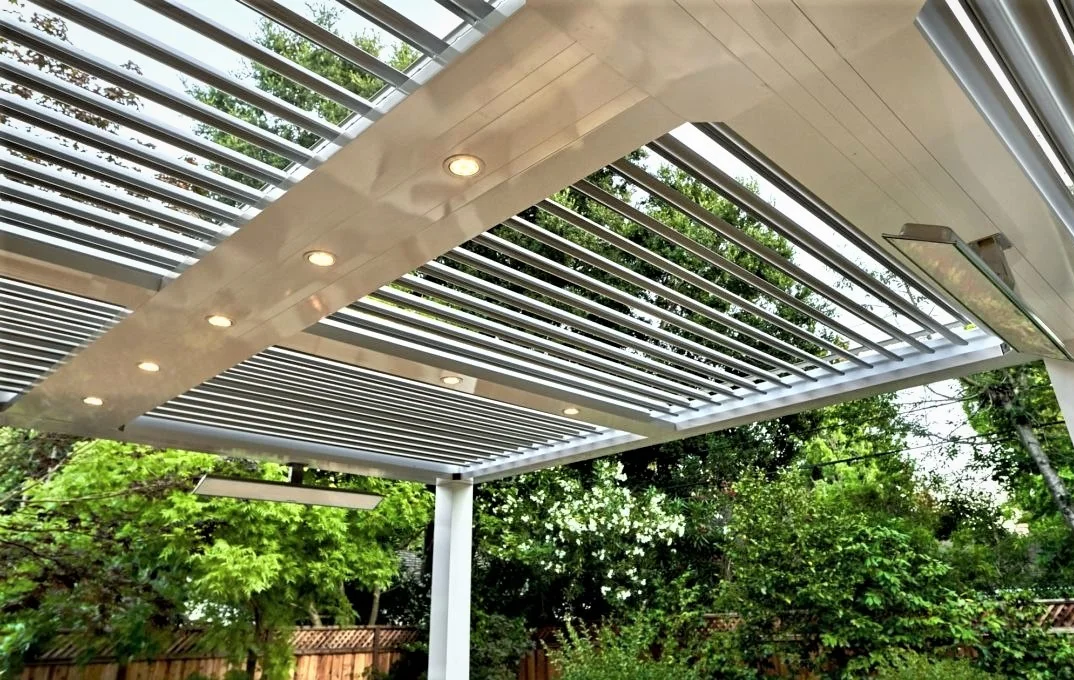
The correct sequence for a pergola roof replacement
Order of operations decides whether this goes smoothly.
First, get both contractors on site together before either one starts. Ten minutes of shared walkthrough prevents most of what goes wrong later. Second, have the pergola company document the existing connection with photographs and, where relevant, the original engineering. Third, agree in writing on the trim, cladding and gutter work. Someone must own whatever crosses the boundary.
Then the roofer works. Tear-off, deck inspection, secondary water barrier, underlayment, and finally the new covering. At the pergola line the roofer installs new flashing rather than reusing the old. Reused flashing is where callbacks come from.
Finally the pergola contractor returns. That visit covers trim, sealant at the penetrations, fastener torque and re-commissioning the motor and sensors. Insist on that last step. A roof crew has no reason to know how the automation and rain sensors are supposed to behave.
Flashing details that decide whether it leaks
Nearly every failure at this junction is a flashing failure, not a structural one.
Where a ledger penetrates the roof plane, the fasteners must sit above the water line. Seal them with a compatible, UV-stable product rather than whatever tube is on the truck. Counterflashing belongs in a reglet or lapped under the course above. Surface caulk alone is not a defence. In addition, the drip edge has to return correctly at the pergola. A shortcut there sends water behind the fascia, where nobody sees it for two years.
Tile roofs deserve extra care. Barrel tile is common across Miami-Dade and Palm Beach. Its attachment detail differs substantially from shingle. We cover that separately in our notes on pergola placement and setbacks, but the short version is simple. Tile work at a structural attachment belongs to a roofer who does tile daily.
Warranty: the part that costs money if you get it wrong
Two warranties are in play, and each has language about the other.
Roofing manufacturers commonly exclude damage from penetrations that others install. So a ledger can go back through a new roof without the roofer’s sign-off. Then the manufacturer can decline a claim at that location. Equally, a structural warranty assumes the connection stays as engineered. Loosen it, shim it or move it during a re-roof and that assumption fails.
Ask both parties to confirm in writing that they inspected and accepted the other’s work at the junction. It takes one email. Furthermore, keep the documentation, because it becomes relevant later at closing, as we explain in our piece on permit history when selling a Florida home.
Permits, code and licensing in South Florida
A re-roof is permitted work everywhere in South Florida. Changing the pergola connection may fall under the existing permit. Alternatively it may need its own, depending on the jurisdiction and the extent of the change.
Roof requirements sit in the Florida Building Code, and the roof-deck and secondary-water-barrier provisions trace to Florida Statutes §553.844. Products used in the High Velocity Hurricane Zone carry Miami-Dade approvals; Miami-Dade Regulatory and Economic Resources publishes the current listings. Note one difference. StruXure engineers each structure for its specific address rather than selling against a generic approval number. Therefore the engineering package for your build is the document your inspector wants.
Confirm both contractors hold current licences through the Florida DBPR. Roofing is a separate licence category from general or specialty structure work.
Timing the two projects together
Adding a pergola now, with five years of roof left? Mount it to the wall where the structure allows, or go freestanding. That single decision removes the future conflict.
If the roof is due within two years, replace the roof first and install the pergola into the new assembly. That order gives the pergola installer a clean, documented substrate. It also gives the roofer no reason to disclaim anything. Homeowners planning both at once should read our guidance on adding a pergola during construction, because much of the coordination logic is identical.
Also consider hurricane season. Nobody wants an open roof deck in September. Broadly, December through April is the calmer window. Those months also overlap with the maintenance thinking in our seasonal checklist.
What it costs
The incremental cost of coordinating a pergola roof replacement is usually modest: a service call to detach and reinstall trim, new flashing materials, and a commissioning visit. Nothing exotic. Expect several hundred to a couple of thousand dollars. The length of the connection drives it, as does any motor and sensor re-alignment.
Now compare a single leak traced to reused flashing. That means drywall, insulation, possibly cabinetry, and an insurance conversation of the kind described in our Florida pergola insurance guide. The coordination is cheap.
Frequently asked questions about pergola roof replacement
Does a pergola roof replacement require removing the whole structure?
Rarely. Most attached systems need only the trim, cladding and connection zone opened up. Full removal is unusual. It normally signals a mounting method that was never right.
Can the roofer just work around the pergola?
Around a wall-mounted structure, often yes. Around a fascia-mounted one, no. The ledger sits exactly where the drip edge and underlayment end.
Who is liable if it leaks afterwards?
Whoever last touched the flashing. That is why written sign-off from both trades beats any verbal assurance.
Will a pergola roof replacement affect my wind mitigation credit?
The re-roof itself usually improves it. Ask your inspector to re-run the wind mitigation form afterwards. The credit follows the new roof deck attachment and covering.
Should I upgrade the pergola at the same time?
If the motor is near end of life, yes. Access is open and labour overlaps. Our notes on motor service life cover the timing.
Getting the sequence right
Coordinate early. Replace the flashing rather than reusing it. Then collect written acceptance from both trades. Those three habits handle almost every risk in the job.
If you are scheduling a re-roof on a house with a StruXure system, contact our service team before the tear-off begins. We will meet your roofer on site.