
Waterfront Pergolas in Jupiter and Palm Beach County: Wind Exposure and Salt Air
The sites people most want a pergola on are the sites that punish structures hardest. Waterfront pergolas in Jupiter, Palm Beach and along the Intracoastal sit in the two most aggressive conditions South Florida offers at the same time: the highest wind exposure in the state’s classification system, and continuous salt aerosol.
A structure built to inland assumptions and placed on a dock, a seawall or an oceanfront terrace will be under-engineered and under-specified. This guide explains exactly what changes at the water, and what a structure has to be to last there.
Exposure category: why waterfront pergolas are engineered differently
Florida’s structural code does not treat every site as equally windy. Design wind pressure depends on more than the mapped wind speed for your county — it also depends on the surface roughness upwind of your building, expressed as an exposure category.
An inland subdivision surrounded by houses and mature trees is a rougher surface; buildings and vegetation slow the wind before it reaches you. A site facing open water has essentially nothing upwind to slow anything, so wind arrives at close to full velocity. In the code this is the difference between a sheltered exposure and the most severe one, and it is not a small adjustment — the design pressures a structure must resist can be substantially higher for the same nominal wind speed, purely because of what is upwind.
This is why two structurally identical-looking pergolas, one in a Jupiter subdivision and one on a seawall a mile away, are genuinely different structures underneath. The waterfront version needs larger footings, more anchors and heavier members to resist the same storm. Anyone quoting a waterfront site from a standard span table is quoting the wrong structure.
Uplift is the governing force
The instinct is that wind pushes down on a roof. It does not. The dominant force on a roof plane in a windstorm is suction — negative pressure lifting the structure away from its anchors — and it concentrates at edges and corners. On an open waterfront site with no upwind shelter, that uplift is at its worst. Everything about how a waterfront structure is anchored follows from this.
Salt: what corrosion does to waterfront pergolas over time
Wind is the design problem. Salt is the durability problem, and it works slowly enough that shortcuts are invisible for years.
Chloride-laden air settles on every surface, wicks into crevices, and concentrates wherever moisture lingers — fastener heads, cut edges, laps and unsealed penetrations. Aluminum itself handles this well; it forms a protective oxide layer and does not rust. The vulnerability is at the connections, where aluminum meets stainless steel or other metals. Where dissimilar metals sit in contact with an electrolyte, and salt water is an excellent electrolyte, you get galvanic corrosion.
Three specifications control the outcome: the grade of the fasteners, the isolation between dissimilar metals at every connection, and the quality of the coating system including how cut edges are treated. Get these right and a coastal structure performs for decades. Get them wrong and corrosion staining shows at connections within a few seasons. Our guide to why cheaper structures cost more over time covers the full service-life picture.
The maintenance that actually matters on the water
Rinsing with fresh water two to four times a year removes the salt film before it can concentrate. It is the single highest-value maintenance action on a coastal site, it takes fifteen minutes with a hose, and it is the item most often named in warranty exclusions when it has been neglected.
What waterfront sites in Jupiter and Palm Beach County have in common
The region’s waterfront runs from oceanfront in Juno Beach and Jupiter Island, through the Intracoastal and the Loxahatchee River, into the canal and basin frontage of the gated communities inland of it. Each condition has its own character.
Oceanfront and beachfront
The most severe of the three. Full exposure, constant salt, wind-driven sand, and often a location within the state’s Coastal Construction Control Line, which adds a permitting layer of its own. Structures here justify the highest coating and fastener specification available.
Intracoastal, riverfront and dockside
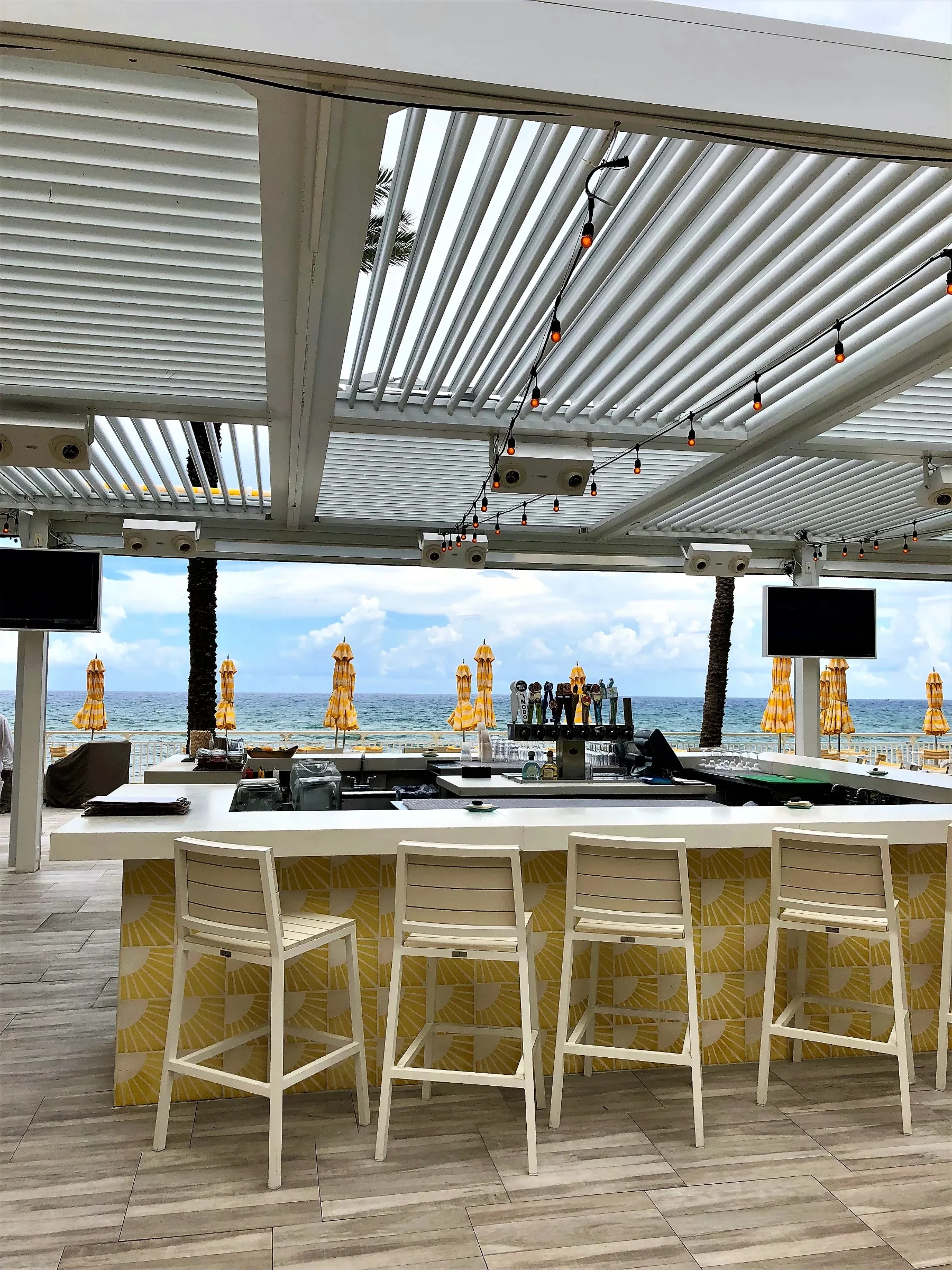
Nearly as exposed to wind across the open water, and salt levels remain high. The design questions are usually about sight lines — a waterfront structure that blocks the view it was built to frame has failed at its main job. This is where adjustable louvers earn their keep: open blades preserve the sky and the view, closed blades provide shade and rain cover. Structures serving docks and boat facilities have their own considerations, covered in our page on marina and yacht club structures.
Canal, basin and golf-course frontage
Meaningfully less severe than the ocean but not inland conditions either. Salt still travels, and a long open fairway or basin still reduces the roughness upwind. These sites usually sit in gated communities where an architectural review committee has its own requirements on colour, height and placement, running in parallel with the building permit.
Design choices that work better on the water
Beyond the structure, a few decisions consistently pay off on waterfront sites.
- Lighter finish colours run cooler under direct sun and show coating chalk later than dark ones.
- Adjustable louvers over fixed cover, because the view is the reason for the site. A solid roof takes it permanently.
- Motorized screens on the windward side — see retractable screens — turn a breezy terrace into a usable one, and retract out of the view when conditions are good.
- Wind and rain sensors. Automation that closes the roof and retracts screens without you being there is worth more on an exposed site than anywhere else.
- Generous drainage capacity. Wind-driven rain arrives sideways and in volume; the gutter and downspout path needs to handle it.
Permits and product approvals on a waterfront site
Waterfront projects in Palm Beach County follow the same permitting sequence as any permanent structure, with additional review where a site sits seaward of the Coastal Construction Control Line or within a municipality with its own coastal provisions. Structures near the water may also fall under a homeowner association or architectural review process.
Products used in the assembly should carry a current Florida Product Approval, which you can look up through the state’s approval search. It is worth being precise about what that means: an approval confirms a product met a standard within the sizes and pressures it was tested at. It is not an approval of your structure at your address. What closes that gap is signed and sealed site-specific engineering, which is how every StruXure structure is permitted. Our Florida permit guide and our overview of whether pergolas are hurricane-proof cover the surrounding questions.
Frequently asked questions about waterfront pergolas
Are waterfront pergolas more expensive than inland ones?
Yes, and legitimately so. Higher design pressures require larger footings, more anchors and heavier members, and coastal-grade coatings and fasteners cost more than standard ones. The premium reflects a structure that is genuinely built differently, not a location surcharge. Our South Florida cost guide explains how exposure feeds into pricing.
Can a pergola be built on a dock or over a seawall?
Often, but it depends on what the dock or seawall was engineered to carry and what the local jurisdiction and any submerged-land authority permit. A structure adds both dead load and substantial uplift to a dock that may never have been designed for either. This has to be assessed by an engineer before design, not after.
How close to the ocean is too close for an aluminum pergola?
There is no distance at which aluminum stops working. What changes with proximity is the specification required and the maintenance expected. Directly oceanfront structures need the best available coating and fastener package plus a regular rinse; a mile inland the requirements relax considerably.
Do waterfront pergolas block the view they are built for?
A fixed roof will, permanently. An adjustable louvered roof does not have to — with the blades open you keep the sky and the sight line, and you only close them when you want shade or shelter. Column placement is the other half of the answer, and it is worth designing the structure around the view rather than around the furniture.
Get your waterfront site assessed
Exposure category, distance from salt, and what your dock or terrace can carry are all site-specific facts, and they determine the structure before anything else does. If you have a waterfront property in Jupiter, Palm Beach County or anywhere along the coast, request a consultation and we will start with the site. You can also explore the Pergola X and Cabana X systems, or see our work in Jupiter and West Palm Beach.